




BBC News NI south west reporter

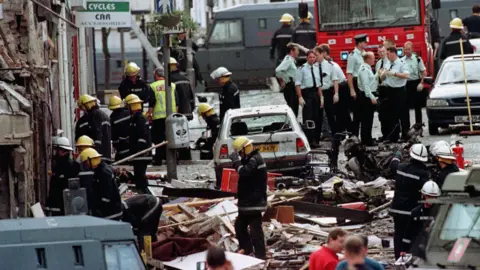 PA Media
There is a “moral, human and legal imperative” on the Republic of Ireland government to establish a parallel inquiry into the Omagh bombing, the official inquiry in Northern Ireland has heard.
The counsel for some of the families of victims and survivors said they were “sick and tired of platitudes, false promises and the grand but empty words from the state authorities of the Republic of Ireland”.
The Real IRA attack on 15 August 1998 murdered 29 people, including a woman who was pregnant with twins.
The public inquiry was established to examine if the attack could have been prevented by UK authorities.
‘Speaks far louder’
On Tuesday, the inquiry heard perpetrators of the bombing enjoyed “cowardly refuge” in the Republic of Ireland.
The inquiry heard the failure of the Republic of Ireland to establish a parallel inquiry was a source of upset for the families.
The Irish government’s “ongoing failure to provide real and meaningful co-operation with this inquiry speaks far louder than their words,” Alan Kane KC said.
He said the memorandum of understanding, signed in April to allow the inquiry access to material held by the Irish government, did “nothing to give our clients any degree of confidence”.
He said the unilateral power of redaction remained with the government of the Republic of Ireland.
The inquiry heard sharing of intelligence between the UK and Irish security services was not productive because it was rare for An Garda Síochána (Irish police) to share information “which would allow for pre-emptive operational action against subversives”.
Mr Kane raised concerns about documentation which had not been disclosed to the inquiry including a missing “threat book”.
He outlined what he said was “a most astonishing, shocking and incredible revelation” which was provided in a corporate witness statement from the Police Service of Northern Ireland (PSNI).
Security policy meetings attended by the Northern Ireland secretary and other senior representatives have only been found for 1996, but none for 1997 and 1998.
Mr Kane told the inquiry the absence of that material left “our clients with a distinct lack of confidence and assurance in the co-operation of the state core participants, in particular the PSNI”.
Quoting from the corporate statement on behalf of the PSNI, Mr Kane said: “The PSNI has not located any record of the RUC engaging with any other organisations within the Republic of Ireland with responsibility for gathering intelligence about the activities of those engaged in acts of terrorism, other than An Garda Síochána.
“At this early stage of the inquiry these are initial responses which fill the hearts of our clients with considerable disquiet and bode ill for the efficacy of the work of the inquiry, despite its best intentions in the days ahead.”
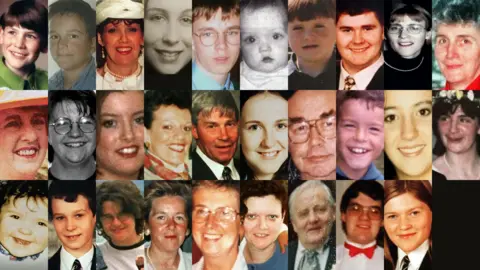
The legal counsel speaking on behalf of some of the victims and survivors of the Omagh bombing says that the security services “desire to protect state agents” could have allowed some terrorist activity to take place.
Speaking on the second day of the second chapter of the inquiry Hugh Southey KC outlined the role of intelligence services and informants in gathering information about dissident republican activity.
He noted that “the absence of any rules or guidance governing the use of informers” potentially allowed risks to be taken with public safety.
“The submission that risk could be taken with public safety is supported by clear findings in the past that the focus of intelligence handling was on protecting agents and, that as a consequence, there were a degree tolerance to terrorist activity”.
‘Effective protection of the bomb
Mr Southey KC also addressed the co-operation of the Republic of Ireland with the inquiry.
“There is little or no doubt that dissident republican activity linked to the bomb took place in the Republic of Ireland. That suggests that effective protection of the bomb potentially required the assistance of the Republic of Ireland’s authorities”.
“There is reason to believe that intelligence was known by the Garda but not the RUC.”
He called for the “full engagement” of the Irish government so the victims and survivors can get to the truth.
On Monday, Paul Greaney KC, counsel to the inquiry, outlined the need for the core participants to work swiftly to fulfil the inquiry’s requirements.
Statements were read by lawyers representing the PSNI, the secretary of state for Northern Ireland, the Police Ombudsman for Northern Ireland and Sir Ronnie Flanagan, the head of the police at the time of the Omagh attack.
The inquiry also heard from lawyers representing families.
What was the Omagh bombing?
The bomb that devastated Omagh town centre in August 1998 was the biggest single atrocity in the history of the Troubles in Northern Ireland.
It came less than three months after the people of Northern Ireland had voted yes to the Good Friday Agreement.
Who carried out the Omagh bombing?
Three days after the attack, the Real IRA released a statement claiming responsibility for the explosion.
It apologised to “civilian” victims and said its targets had been commercial.
Almost 27 years on, no-one has been convicted of carrying out the murders by a criminal court.
In 2009, a judge ruled that four men – Michael McKevitt, Liam Campbell, Colm Murphy and Seamus Daly were all liable for the Omagh bomb.
The four men were ordered to pay a total of £1.6m in damages to the relatives, but appeals against the ruling delayed the compensation process.
A fifth man, Seamus McKenna, was acquitted in the civil action and later died in a roofing accident in 2013.
