




Clara BullockBBC News, Somerset and
Lili SheppardBBC News, Somerset, Langport

 BBC
BBCArcheologists have uncovered a Roman village that could date back to as early as 50 AD.
On Sunday, the site near Langport in Somerset will be open to public so that people can view the village and archaeological findings for the first time.
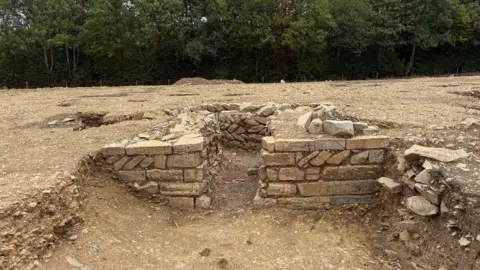
The site includes remains of an old Roman villa, a ritualistic horse burial and luxury items that were used by the occupants.
Agata Socha-Paszkiewicz, regional manager at Thames Valley Archaeological Services South West, said the finds were “quite a significant” and that judging by the size of the site “we are looking at probably several thousand occupants”.
Ms Socha-Paszkiewicz said: “In the villa, there probably would have been extended family as well as servants and slaves at Roman times.
“We have surviving floors and an atrium and evidence of a mosaic, which means they were quite wealthy, upper middle class.”
She said they found fragments of fine glass and hair pins that suggest they were trading with places quite far away from Somerset.
“We have some personal hygiene objects too, like tweezers. They are different objects that can tell us what life was like, how far they traded,” Ms Socha-Paszkiewicz said.
She added that the most common items they found was pottery and animal bones, as well as more than 60 coins.
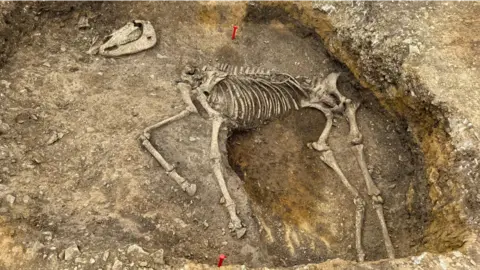
However, the most interesting find was a buried horse, she said.
The remains show it was buried on its side, with its legs arranged to look like it was still galloping.
“It usually would have been a ritual or spiritual act. That’s quite spectacular and quite a rare find,” Ms Socha-Paszkiewicz said.
People will be able to see the horse grave as part of the open day on Sunday.
