




Emma VardyBBC Panorama reporter

 BBC
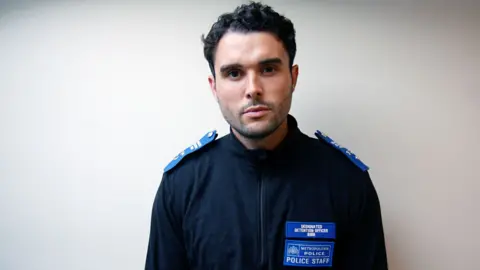
BBCAdjusting his uniform, Rory Bibb glanced in the mirror before setting off to start his new job. “I feel ready,” he told his video diary.
This was no ordinary first day. For the next seven months, Rory was employed as a designated detention officer at London’s Charing Cross police station. He was also secretly working for Panorama, capturing shocking video evidence of misogyny, racism and officers revelling in the use of force.
The BBC had placed an undercover reporter within the UK’s largest police force.
For responsible investigative journalists, the decision to undertake covert filming like this is never an easy one. Going undercover involves deception and intrusion as tools of public interest journalism, and to justify this there needs to be sufficient evidence of wrongdoing.
And in Charing Cross police station, one of the capital’s busiest, there was plenty to suggest that all was not right.
Getting inside
For any reporter, going undercover is an intense experience.
“Walking in on the first day, and going through those doors of a police station, it’s literally the last place on earth you’d want to be wearing secret cameras,” he told me.
He was under near-constant surveillance. Plus, he said, at all times, “you’re around the people who do the investigating.”
And so began a double life. As well as gathering evidence about the culture among officers, Rory had to undertake all the duties of a designated detention officer.
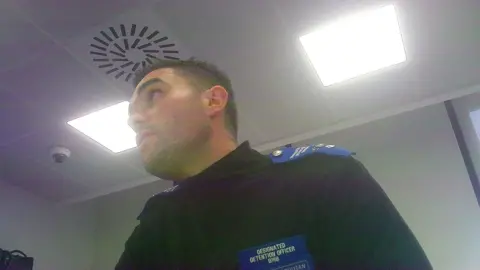
Rory was a journalism graduate who had worked in PR. He had completed an online application – not mentioning, of course, that he was working for Panorama – and passed vetting.
After a job interview, Rory, then 28, was accepted for a job as a detention officer in Charing Cross custody suite, helping to make sure detainees were fed, watered, and kept safe.
Before he started, Rory knew all about the station’s reputation.
Rules of engagement
Working with Panorama, Rory was backed by a very experienced BBC team which had carried out many other undercover investigations.
Unknown to his colleagues at Charing Cross, Rory came into work for almost every shift wearing specially constructed hidden cameras and recording equipment.
Over the next seven months, covert recording allowed the BBC to gather clear evidence corroborating what whistleblowers had described.
For Rory, working undercover was at times “an emotional rollercoaster”.
“You always have to be switched on and it’s a 12-hour shift,” he told me, adding that the deception had to extend outside work in order to protect the confidentiality of the investigation. “You’re also lying to your friends. You’re lying to your family members.”
Before and after each shift at Charing Cross, Rory was closely monitored and supported by an experienced Panorama team, and the evidence he gathered was regularly reviewed by a senior team from the programme.
Some of his footage was also reviewed by a former chief constable and a former attorney general – the government’s principal legal adviser – so they could give an expert view on the evidence.
And my job, as the programme’s presenter, was to clearly and transparently communicate the evidence Panorama had found and how the team had gone about gathering it for the public.
In February 2025, Met Commissioner Sir Mark Rowley told the BBC’s Today programme: “The public can have confidence in us.”
But had the Met really changed?
Whistleblowers told BBC Panorama that efforts to repair the force’s culture had not been as successful as its leadership had publicly claimed and that the Met still struggled with deep-rooted misogyny and racist attitudes within its ranks.
The whistleblowers specifically highlighted Charing Cross police station as a source of concern.
Rory’s post would allow him to observe the culture within the station up close, without taking on the duties of a fully fledged police officer. After seven weeks training by the Met, he was ready to start work.
A culture of secrecy
During breaks on long shifts, Rory would go out to a yard at the centre of the station where everyone smoked and vaped. “I didn’t find it hard to speak with people,” Rory says. But it proved difficult to build their trust.
A culture of secrecy at the station quickly became apparent.
“From the very beginning of my time working at Charing Cross, I was warned about saying stuff in front of certain people,” Rory says.
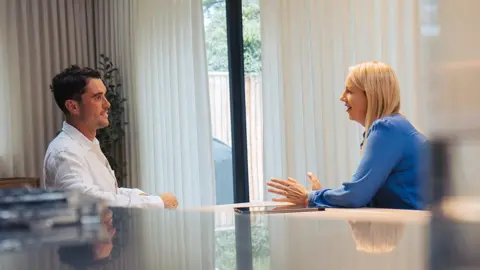
As one PC told Rory, “When you go out with someone new, that you don’t know, you have to reset. You have to put the mask of speaking factual. Someone new joins, boom, mask on. You’ve got to figure them out, what you can and can’t say.”
Not all unacceptable behaviour was concealed. For instance, Rory’s line manager, Sgt Joe McIlvenny, is seen in the documentary holding court over the custody desk, recounting his sexual exploits in graphic detail – to the despair and exasperation of some female colleagues.
However, when Rory asked Sgt McIlvenny about an incident in which the officer had punched a detainee in the leg, the officer ushered Rory into a corridor away from police cameras and microphones. Sgt McIlvenny told Rory to be careful inside the custody suite when discussing the use of force.
But Rory’s covert filming was able to reveal how officers kept evidence of bad practice or wrongdoing concealed. The BBC’s secret cameras captured what the station’s routine monitoring could not.
Beyond the station walls
Inevitably, it became clear that to get a true picture of the culture inside the station, Rory would have to spend time covertly recording conversations outside it – in pubs where officers regularly socialised with colleagues.
You might argue that what is said over a pint cannot be taken as seriously as something spoken when wearing a uniform.
But the Met Police itself has previously demonstrated that officers expressing discriminatory views in private spaces, such as WhatsApp groups, or when off duty, are still accountable – and disciplinary rules cover such behaviour outside of working hours.
Some officers have lost their jobs in the past, for words or actions that took place in their free time.
All officers are required to follow standards of professional behaviour laid out in law.
Rory said: “I didn’t realise how hard it was going to be to break into this culture. They’re all holding back all the time unless they’re absolutely certain that they can trust you.”
‘Are you wearing a wire?’
One way Rory was able to win the confidence of colleagues was telling them he was thinking of becoming a police officer.
He was then invited to join a patrol with an officer who would later make a series of anti-Muslim comments during a conversation at the pub.
But others were more cautious. Another officer, PC Phil Neilson, even asked Rory if he worked for the Met’s Directorate of Professional Standards and if he was wearing a wire.
Rory and PC Neilson also went to the pub together, but the officer appeared to signal that he was still suspicious and holding back: “I was hoping you would say something more controversial and then I’d be like, ‘Ah yeah, calm, let’s go for this,'” he told Rory.
Two weeks later, the two men met up outside work again.
“From the moment I walked through the doors, I tried to match his energy more,” said Rory. “I tried to make him feel I was more on-side. Just by agreeing with him, laughing along with him… making him feel that, you know, he could trust me.”
During this night out, PC Neilson opened up to Rory further, making a series of racist and violent remarks.
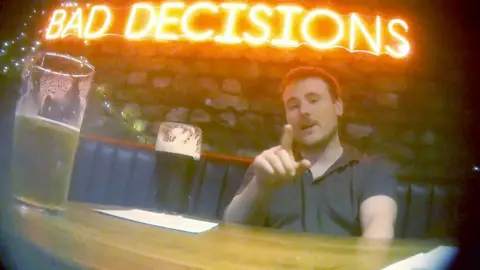
“He’s policing the streets of London, one of the most multicultural cities in the world, and he holds these views,” Rory told me afterwards.
“This guy holds a lot of power, a lot of responsibility.”
Winning the trust of these officers often meant nodding along, or even laughing, perhaps appearing to agree, in conversations in which extremely racist views were aired.
Describing his interactions with PC Neilson, Rory said: “You’re face to face with a police officer that’s clearly anxious about you, and got question marks about you, and has given you an invite to offer more.”
I put it to Rory that it sounded like he was agreeing with the officer’s views.
He replied: “I didn’t want to shut him down because when, someone’s literally told you that ‘I was going to go further but I didn’t, because you’re nowhere near my level’, I had to show him something.”
Rory added: “There’s elements of it that I feel uncomfortable with. It’s so far removed from me. It’s really strange to watch back.
“But when I walked through the doors of Charing Cross police station, I was trying to reflect the culture that I was experiencing.
“I wasn’t being me.”
At the station, Rory saw dozens of police officers every day. Many appeared to be working professionally and with empathy.
“I saw so many police officers doing their job to the best of their ability, and who at least seemed to me to be in policing for the right reasons,” Rory told me.
“Hats off to them, because it’s challenging.”
But the racist and misogynistic behaviour highlighted in our film shows that the problems which have tarnished the Met’s reputation in the past had not gone away.
Driven underground
All the officers identified in the film were contacted for their response. They have not responded.
Panorama wrote to the Met with details of the evidence gathered. In his response, Commissioner Sir Mark Rowley said the behaviour outlined was “disgraceful” and that the force had taken “immediate and unprecedented action” to investigate.
He also said that eight officers and one staff member had been suspended and another two officers had been removed from front-line duties.
He added that the Met has “dismantled the custody team at Charing Cross, made changes to local leadership” and was looking more broadly at other Met detention teams.
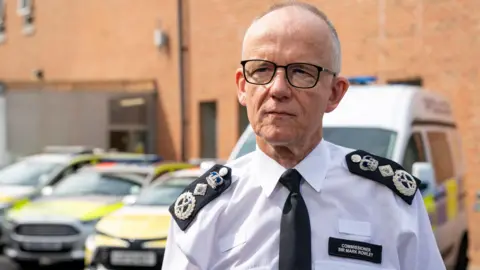
Sir Mark also said: “Much more needed to be done to tackle the individuals and cliques whose appalling behaviour continues to let down their colleagues and Londoners”. The Met’s “resolve to identify, confront and get rid of them is absolute,” he added.
The Met has referred Panorama’s allegations to the Independent Office for Police Conduct (IOPC), which has launched its own investigation.
Panorama’s investigation suggests a culture within the Metropolitan Police in which racist and misogynistic attitudes continue to exist in its ranks.
It is clear the Met has taken steps aimed at trying to address behavioural and cultural issues.
But the evidence also suggests that a toxic culture hasn’t been eliminated – but driven underground.
