




Sarah TurnnidgeWest of England

 Family handout
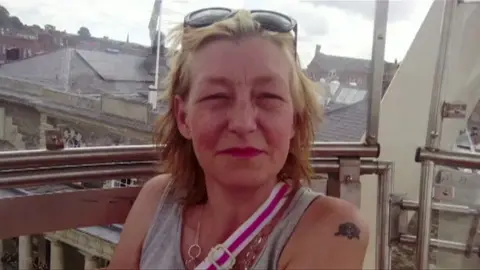
The final report into the death of Dawn Sturgess, who was poisoned by the nerve agent Novichok in Salisbury in 2018, will be released later on Thursday.
In late 2024, an inquiry heard six weeks of public evidence about links between her death and the attempted murder of former Russian double agent Sergei Skripal and his daughter Yulia.
These open hearings were followed by private sessions in January 2025 during which highly classified information from the UK security services was presented.
Who was Dawn Sturgess and what happened to her?
A murder inquiry was launched after Dawn Sturgess, 44, died from Novichok poisoning in Salisbury Hospital on 8 July 2018.
The mother-of-three was fatally poisoned after spraying herself with the contents of a perfume bottle which contained a “significant amount” of the nerve agent. The inquiry heard there was enough Novichok to “kill thousands”.
Her partner Charlie Rowley told police he had found the perfume in a charity collection bin on 27 June.
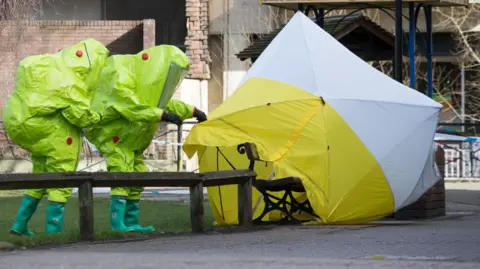
Ms Sturgess collapsed at Mr Rowley’s house in Amesbury, about seven miles from Salisbury, shortly after opening the perfume on 30 June.
He also became ill but was discharged from hospital on 20 July.
 Getty Images
What are nerve agents and what is Novichok?
Nerve agents are highly toxic chemicals that prevent the nervous system from working properly and can be fatal.
They can take different forms – including powder and gas – but tend to be a liquid, which can seep through the skin.
“Novichok” means “newcomer” in Russian and refers to a group of advanced nerve agents which were developed by the former Soviet Union in the 1970s and 1980s.
The chemicals are extremely effective in very small quantities and need to be transported in tightly sealed containers by someone wearing protective clothing.
Who are Sergei and Yulia Skripal and why were they poisoned?
 Reuters/BBC
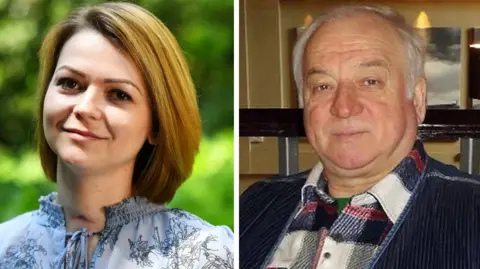
Former Russian double agent Sergei Skripal and his daughter Yulia were poisoned on 4 March 2018.
Mr Skripal had been accused by Russia of spying for Britain’s MI6 and jailed in 2006. He was later pardoned and allowed to settle in the UK in 2010.
His wife, son and older brother had all died in the two years before the 2018 attack.
Yulia Skripal had arrived in the UK from Moscow the previous day.
The pair had gone for lunch in Salisbury before they were both found collapsed “in a serious condition” on a bench in a shopping centre.
It was subsequently discovered that they were suffering from the effects of a chemical which had been left on the doorknob of Mr Skripal’s home.
That was later identified as Novichok by experts at the Defence Science and Technology Laboratory at nearby Porton Down in Wiltshire.
Ms Skripal was released from hospital on 9 April and her father was discharged on 18 May. Both are believed to have made a full recovery.
However, their movements since the attack have remained secret for their own protection.
Police officer Det Sgt Nick Bailey, who was the first person to enter the Skripal house, spent nearly three weeks in hospital.
It also emerged in the inquiry that a boy, who Mr Skripal gave bread to so he could feed ducks, also became unwell.
Why was Russia blamed for the attacks and who are the suspects?
 Metropolitan Police
Given Mr Skripal’s identity, the UK government quickly blamed Russia for his attempted murder.
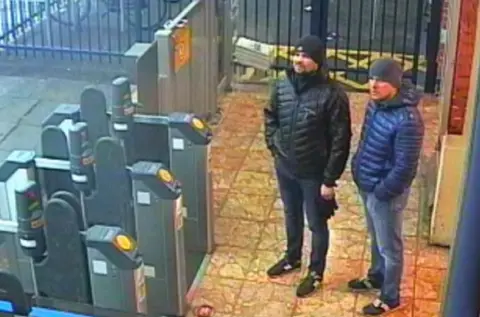
Then Prime Minister Theresa May said the two suspects had arrived at Gatwick Airport from Moscow on 2 March, travelling as Alexander Petrov and Ruslan Boshirov.
The pair – later identified as Russian intelligence officers Anatoliy Chepiga and Alexander Mishkin – were spotted on CCTV in Salisbury the day before the attack.
The two men returned to Moscow on the evening of 4 March.
President Putin denied any involvement and the two accused men appeared on Russian TV, where they insisted they had visited Salisbury as tourists who wanted to see the cathedral spire.
Downing Street dismissed the Russian response.
Another Russian agent, Denis Sergeev, who had been in London under the alias Sergey Fedotov, was later named as a third suspect.
Why was there an inquiry, and how will its findings be released?
When someone dies in an unexpected or suspicious way, a coroner’s inquest is often set up to establish the circumstances which led to the death.
But the previous inquest into Ms Sturgess’ death was converted into an independent inquiry to allow it to have access to the secret intelligence which was heard in private.
An inquiry is not the same as a trial. There is no jury or prosecution and it cannot produce a guilty verdict, but rather sets out to establish where responsibility lies and note any lessons.
Inquiry chairman Lord Hughes heard evidence from NHS staff, police and members of the intelligence services over the course of the sessions, but the Skripals did not appear.
The inquiry’s full report will be published at 12:00 GMT on Thursday 4 December, when Lord Hughes will give a short statement at the International Dispute Resolution Centre in London.
