



Unpopular opinion: Osaka > Tokyo.
Admittedly, Tokyo is fantastic, futuristic, sweeping you up with its quick pace, skyscrapers, neighbourhoods with quirky fashion, pop culture, neon lights, trendy districts like Ginza, Michelin-star restaurants, immersive art exhibitions, bustling nightlife and food scene. The vibe, I thought, was unmatched, till I reached Osaka.
This port city, on the Japanese island of Honshu, has me wrapped around its little finger. I do not know if it is the laid-back charm, the geniality of the locals, their interesting fashion choices (I saw a lot of pinks, from candy floss and neon to raspberry and fuchsia), the perfect weather, the food scene, the shopping, or the fact that I managed to snag a pair of golden Onitsuka Tiger sneakers in my size (which Tokyo failed to source for me). The gamut of experiences here range from traditional tea ceremonies, peaceful shrine visits, and sumo experiences to Mario kart tours, pub crawls, and bar hopping to izakayas. Sensing its potential, luxury hotel chains and bars are investing in real estate in Osaka. The Four Seasons Hotels and Resorts opened its first outpost here in 2024. Gucci unveiled its Gucci Giardino bar last year in the Umeda district, said to be the second-ever after Florence.
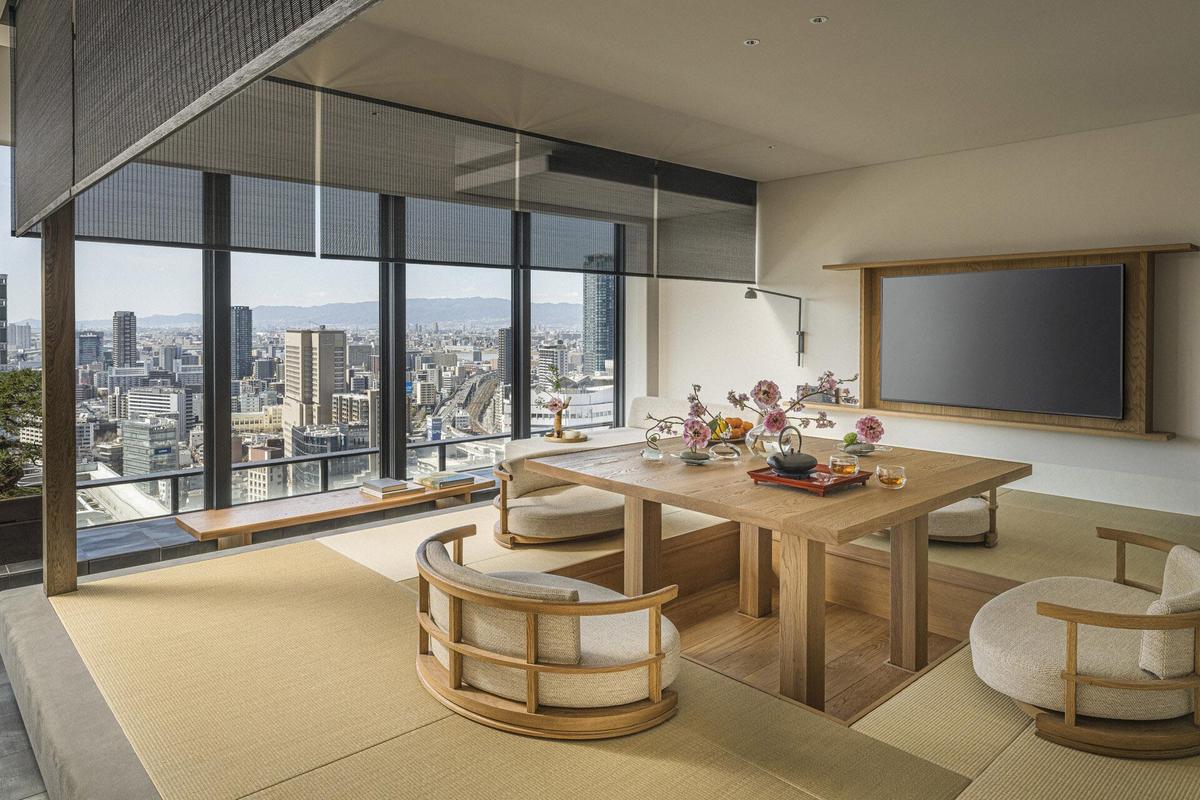
At Four Seasons Osaka, an entire floor is dedicated to the traditional Japanese style of living
| Photo Credit:
Four Seasons Osaka
But my first stop is a dungeon: one that lets me swipe my credit card. Tucked below six interconnected Umeda stations in the area, is a world I never knew or expected. I feel like Harry Potter entering Diagon Alley. I follow the steps that lead to the cavernous belly and enter a bustling underground world commonly known as Umeda Dungeon — a network of shopping malls, stores, and diners. There are alleys that lead to more alleys. Yes, you will get lost and find yourself emerging out of one of the five other stations but wherever you are you will always be ensconced in the comfort of retail therapy. I highly recommend the Lucua complex that houses two buildings brimming with boutiques showcasing local designers and international brands.
Post this, driven by greed to buy more, I find myself entering Don Quijote, the store where chaos meets consumerism. Popularly known as Donki, this is a discount store chain with multiple floors — I gave up counting after three — brimming with cosmetics, skin care, electronics, snacks, costumes, pre-loved bags and no clear instructions on where to find an escalator or steps to move up to the next floor. The long queue from the billing counter spills between the aisles but the staff at the counters are efficient and the queue moves fast. I spend two hours at Donki but in hindsight, I would have liked to spend that time at the Umeda Dungeon.
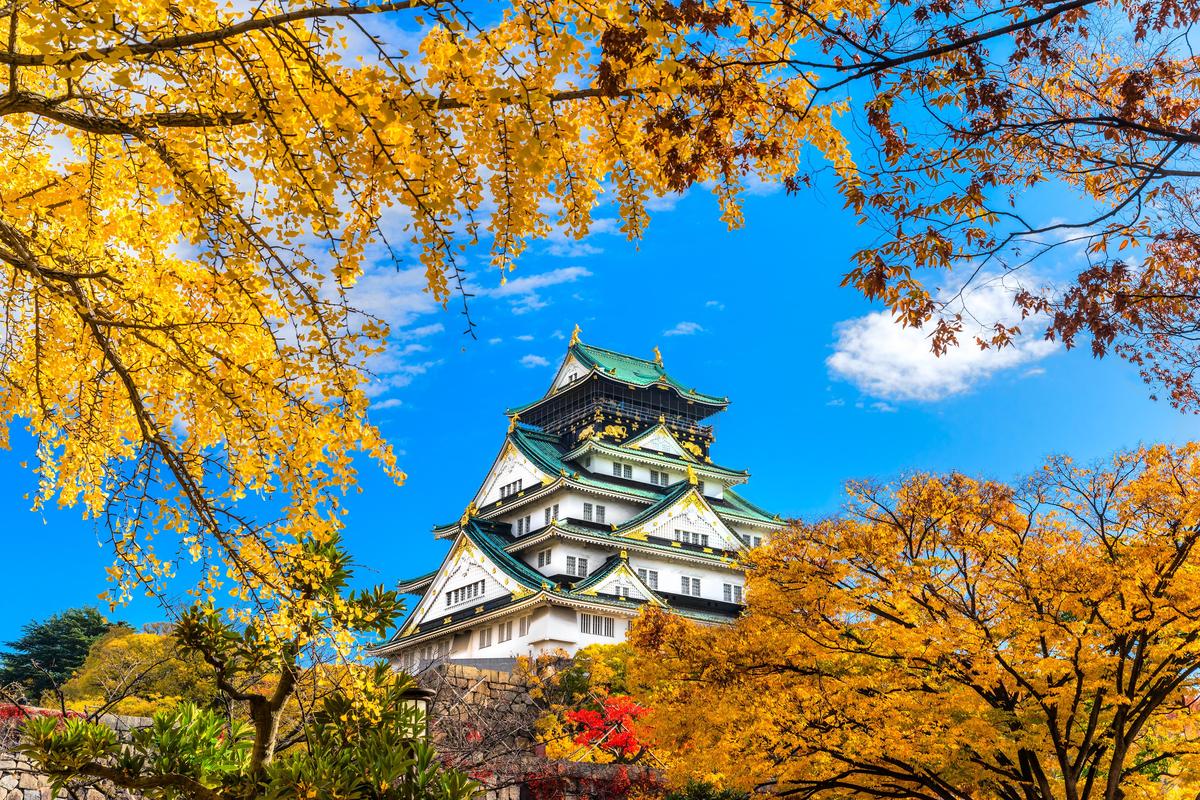
Osaka Castle
| Photo Credit:
MasterLu
Heaving with bags, as I walk the streets, the traditional-modern fusion becomes more apparent. An example is the Four Seasons Osaka that I check into. While the hotel is glitzy with all the trappings of modern life, an entire floor is dedicated to the traditional Japanese style of living. Titled ‘Gensui’ Modern Ryokan floor, it has rooms with tatami flooring where you walk barefoot, a low bed with a special futon, and a bathroom with a deep square tub, a stool, and Japanese bath bucket. The floor to ceiling windows overlook the Osaka skyline — a contrast to this setting — that dazzles at night with its shiny high rise buildings. The breakfast area on this floor serves Japanese staples in bento boxes, and you can also try your hand at traditional arts like origami, kirigami etc.

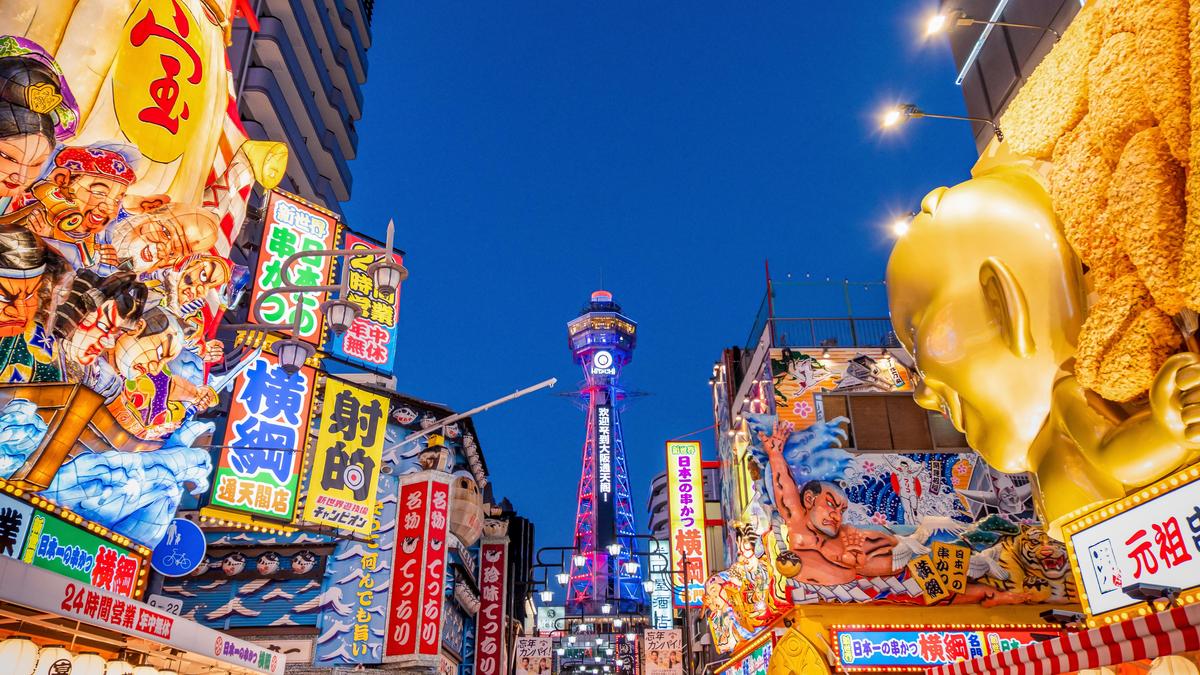
The next morning I am up early to explore the city, first from its waterway. A private Four Seasons boat waits for me and steers me around the Dojima river as we pass by the Osaka Castle, parks, gardens and dancing fountains. From this sanctuary of calm, I proceed to the vibrant, in-your-face district of Shinsekai that looks like the love child of Times Square (New York) and specifically Bangkok’s China Town. Exuding a carnival vibe, this place pulses with retro-style shops, old school arcade games, intimate standing bars with inexpensive food and alcohol, whisky bars, game stalls, street food counters with bright boards and installations, and lanterns sporting bold Japanese letters. It resembles a meticulously put-together movie set from the 80’s and I feel like an extra walking through this maze with hordes of others. And here, I meet Billiken — a portly creature with a tuft of conical hair, pointed ears and an impish grin. He is considered to be a symbol of good fortune and is everywhere — on facades of buildings, keychains, T-shirts, you name it. In most spots, he sits with his legs stretched out atop a tiered pedestal with the words Billiken, followed by THINGS-AS-THEY (shortened version of “God of things as they ought to be” as that is what he is believed to be ). Though quite the hero in Osaka, it is said Billiken was created by Florence Pretz, an American illustrator in the early 1900s.
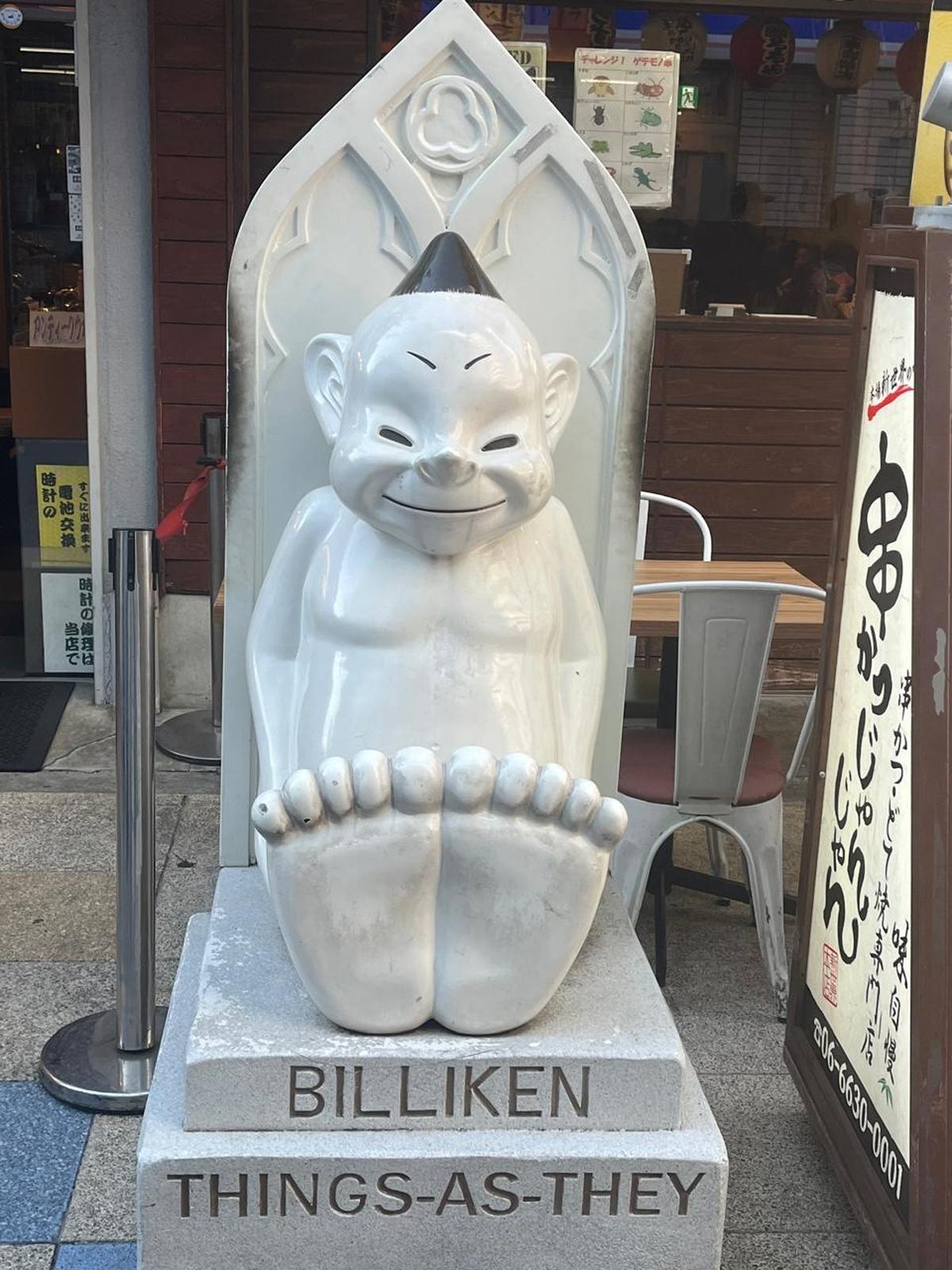
Billiken
| Photo Credit:
Priyadarshini Paitandy
Peckish by now, I do what I am primarily here to do — grab a variety of highly-recommended kushikatsu (deep-fried meat and veggies on skewers): shiitake mushroom, lotus root, cheese, sausage, chicken thigh. It is hard to stop but please do, as more options await down the alley. Gyoza, takoyaki (wheat balls filled with minced octopus, pickled ginger, green onion and tempura scraps), nikujaga (meat and potato stew), okonomiyaki (a savoury pancake), Japanese jerky and something that resembles a South Indian kozhukattai. The food here is so popular that there are local guides offering much recommended food walks. No wonder, Osaka is called the ‘kitchen of Japan’. Nearby, a vending machine gives me the come-hither look with its display of beautiful dessert. I pick a banana dipped in chocolate. This one even has eyes and a mouth, and looks like a work of art fit for Art Basel.
I am told Shinsekai was built in 1912, inspired by New York’s Coney Island and Paris. The Paris reference becomes clear once I notice the 108-metre tall Tsutenkaku tower looming ahead. Drawing inspiration from the Eiffel Tower, this was rebuilt in 1956 after a fire engulfed the original landmark. You can take an elevator to its observation deck to get a bird’s eye view of the city.
As evening falls, the neon-lit Dotonburi district beckons. The famous Glico running man billboard overlooks a canal with bright boats. Tourists mill around to snap a picture in front of the famous sign. Nearby, a giant crab plastered across a facade of Kani Doraku restaurant garners attention. Joining the traditional billboards here are LED lit and 3D billboards. The storefronts and facades too are a touch dramatic with 3D effect, life-size octopus, gyoza, and faces of people.
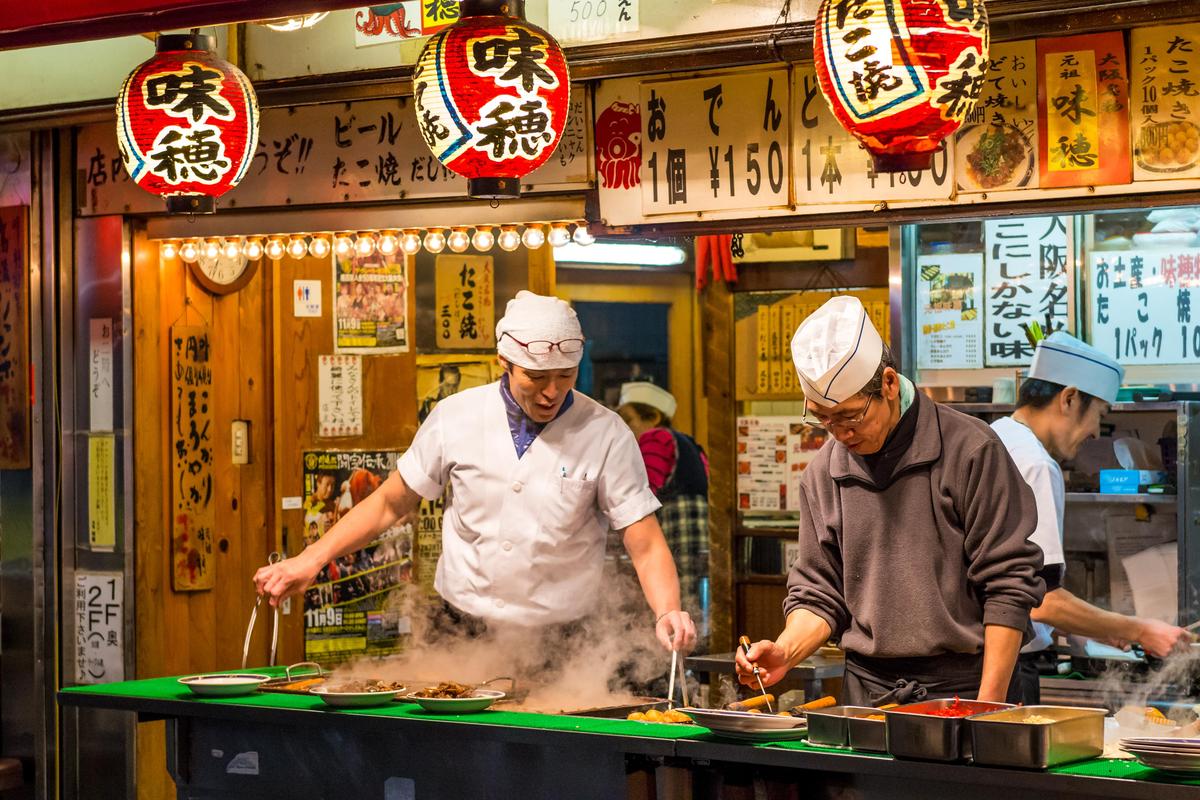
Traditional Japanese street food
| Photo Credit:
VINCENT_ST_THOMAS
A chill breeze blows from the river and I make my way to the covered Sinsaibashi-suji shopping street where you find high street brands like Uniqlo, Zara, and H&M, lined up with cosmetic shops, and food stalls. Like in Tokyo, the Onitsuka Tiger showroom here is packed with people. Mostly travellers, perhaps here for their holy grail. I queue up too, jostle for space inside and confuse myself with the metallic options. But one cannot take too long to decide because while you do, what you want may just be whisked away to the billing counter, right in front of your eyes!
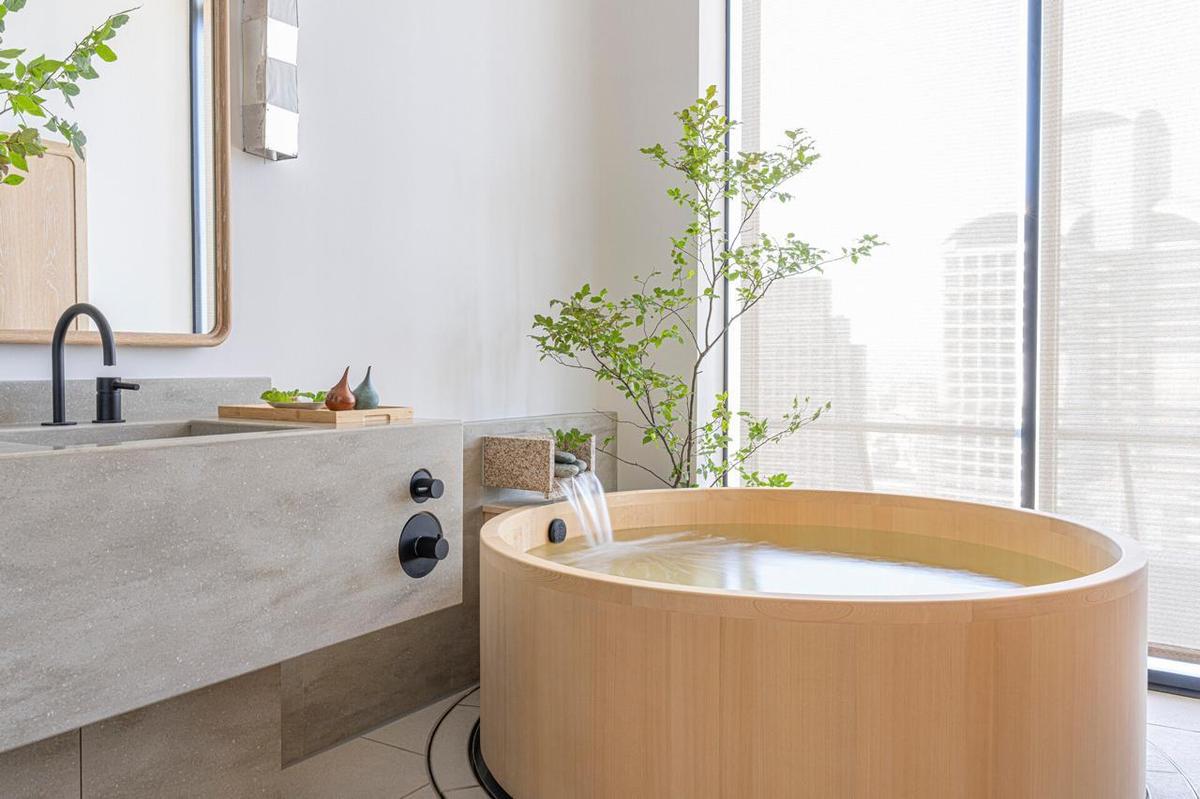
The spa at the Four Seasons Osaka
I could linger at Sinsaibashi for longer but the idea of sundowners at Bar Bota, on the 37th floor of the Four Seasons hotel, seems inviting. The bar serves cocktails crafted with local botanicals, innovative snacks and stellar views of Osaka gilded by the sun’s orange rays. Post that, I reward myself with a massage. I am transported to the spa on the 36th floor where I let the masseuse work her magic while I look out of the floor-to-ceiling windows. The city lights come on, clouds waft through the late evening sky, and eventually a gentle snore escapes my mouth. Good night, Osaka!
The writer was in Japan at the invitation of Four Seasons Hotels and Resorts
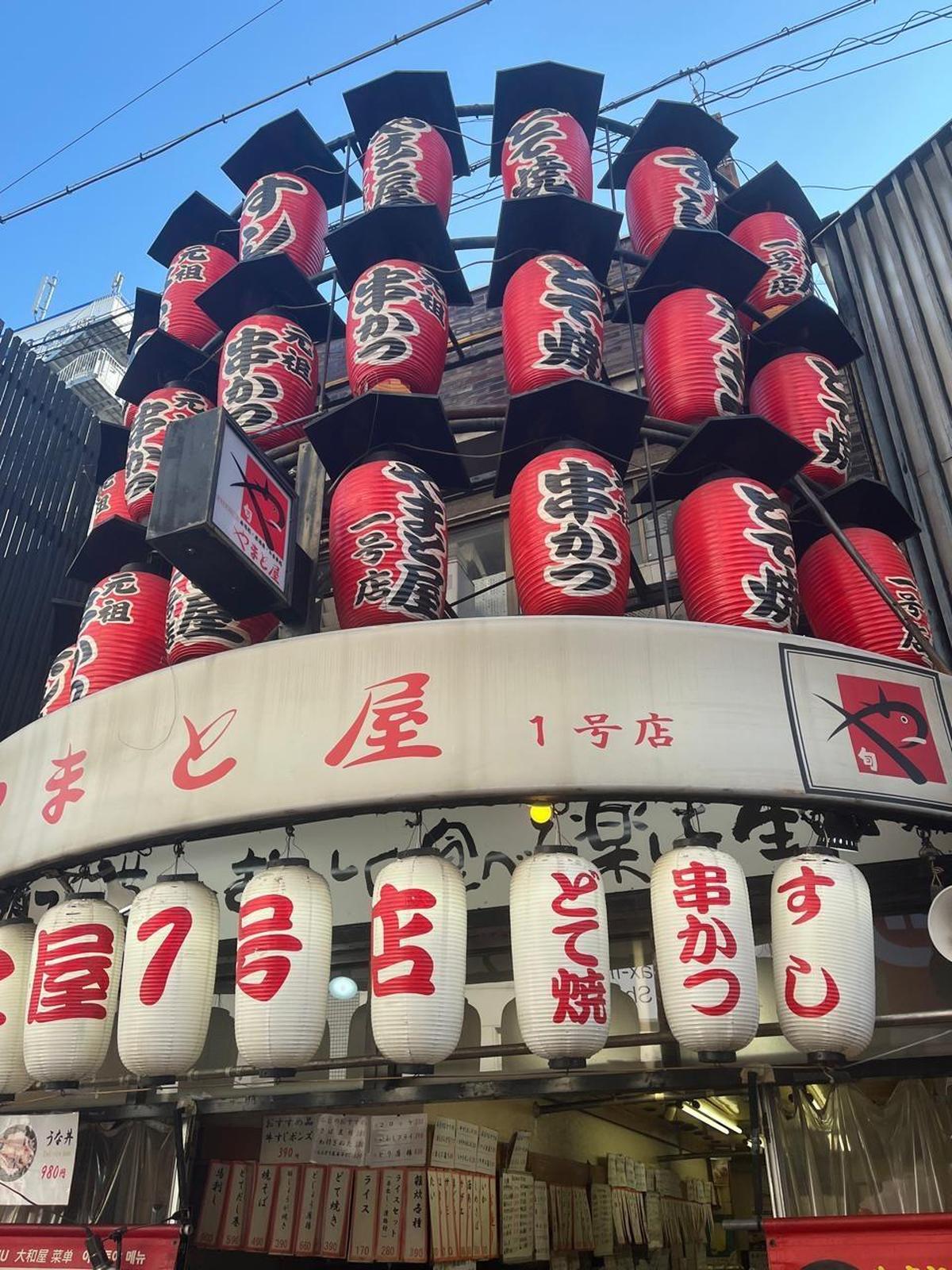
Retro-styled lanterns
| Photo Credit:
Priyadarshini Paitandy
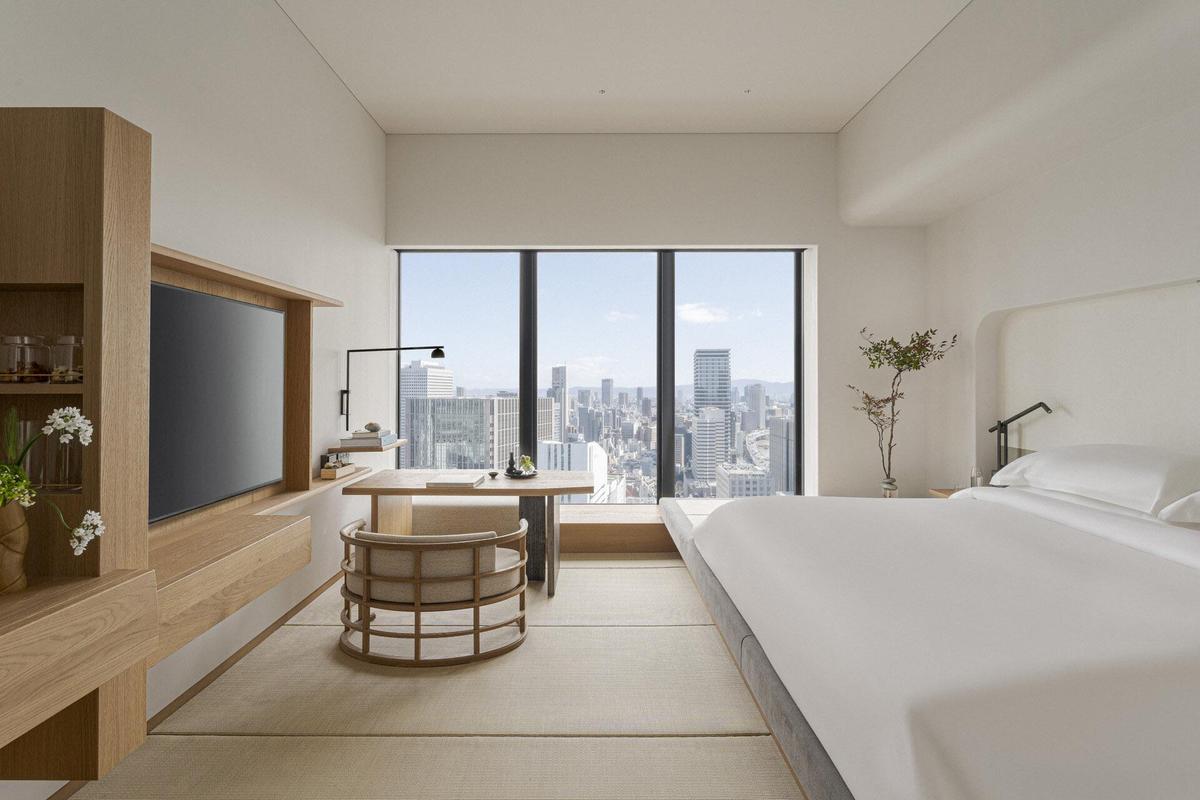
A photo of a traditional room
| Photo Credit:
Four Seasons Osaka
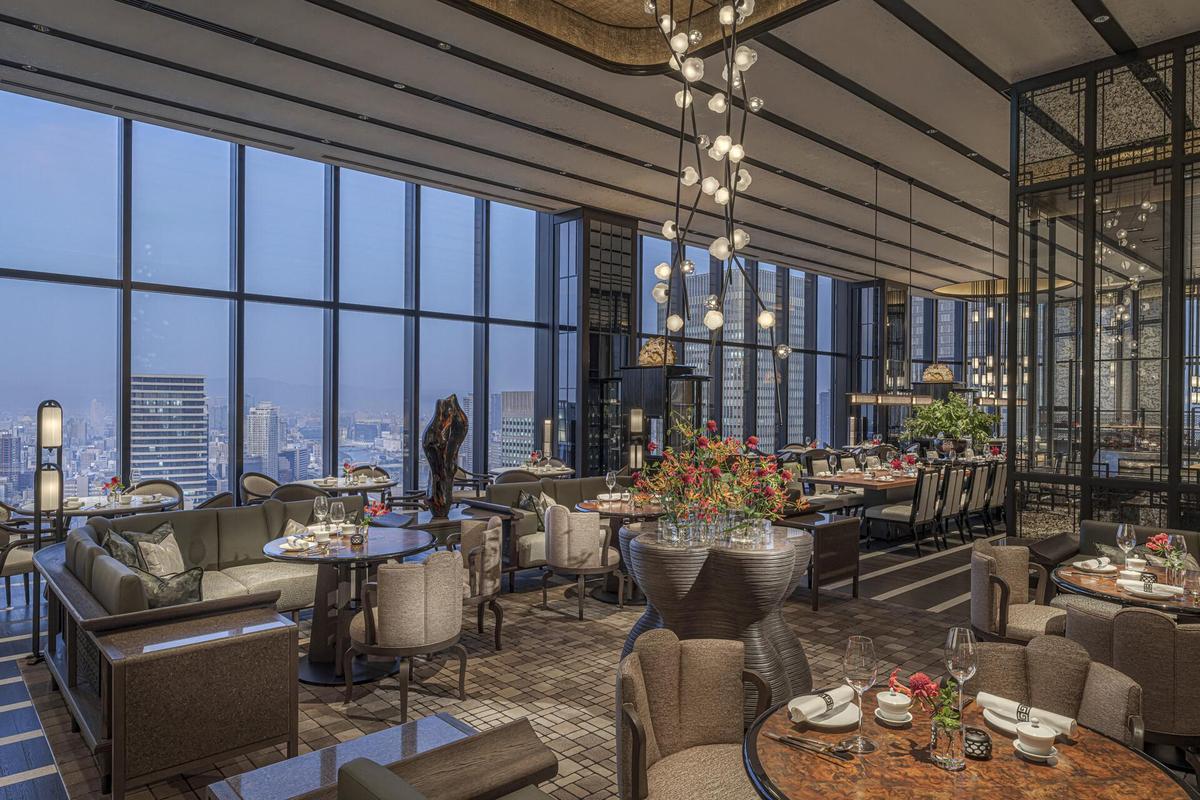
Jiang Nun Chun, Four Season Osaka’s Chinese restaurant on the 37th floor
