



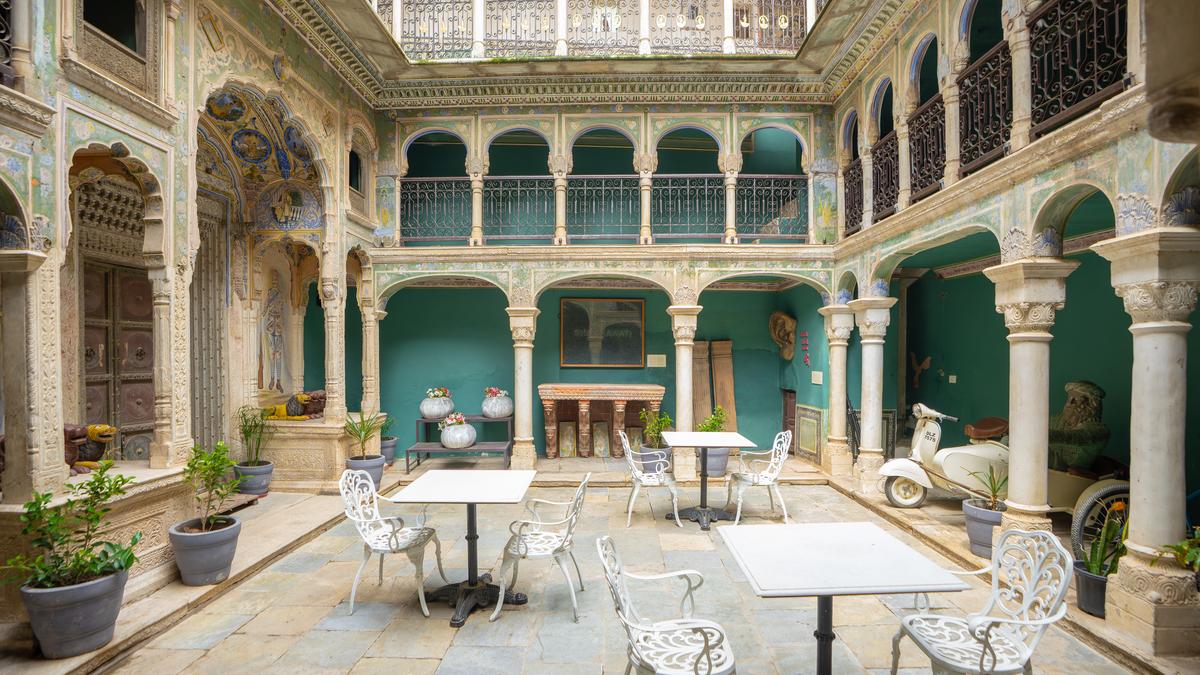
Aabid Khan Kayamkhani is overcome with emotion at the loss of some of the finest works in the havelis of Nawalgarh. As a tour guide, he gives visitors a quick lesson in the place’s history and art. One such haveli has been painted over in cream and pink, leaving a mere door and the space around it as a reminder of the lost art.
“We grew up hearing about and seeing the artwork of these havelis. Our generation has seen this place become this wonderful centre of art. There is no other place in the world that can match Nawalgarh’s havelis,” says Aabid, who also works as a location liaison for movie and OTT shooting crews.
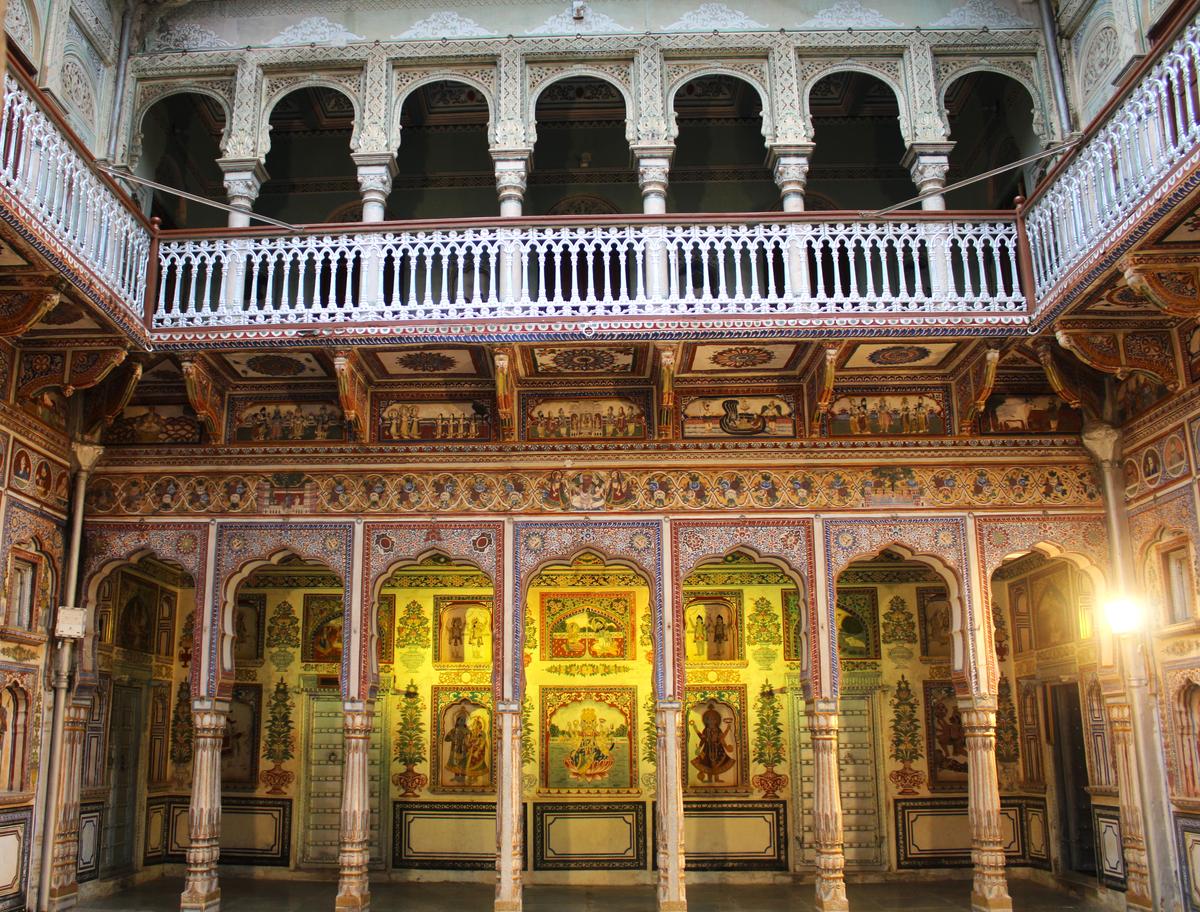
The lit-up inner courtyard of Podar Haveli Museum
| Photo Credit:
Garima Verma
His sentiment might seem amplified but it was his ancestors who stood witness to the history of the region for four centuries before Thakur Nawal Singh founded Nawalgarh in the Jhunjhunu district of the Shekhawati region of Rajasthan. It was a Chauhan prince, Rana Karamchand, who converted to Islam in 1356 under the rule of Firuz Shah Tughlaq, became Kayam Khan and thus, began a community called Kayamkhani, which followed both Rajput and Muslim traditions. Their weddings, thus, had both pheras and nikah.
When Nawalgarh came into being in 1737, the Marwari community flocked to it, making it one of the most affluent places over time. Many well-known Marwari business families, like Jaipurias, Goenkas, Jiwrajkas, Khaitans, Morarkas, Podars, Seksarias, and others have roots in Nawalgarh. And, during the 18th-19th centuries, these wealthy businessmen and merchants built multi-storeyed, multi-courtyard mansions that even put many palaces to shame with their craftsmanship.
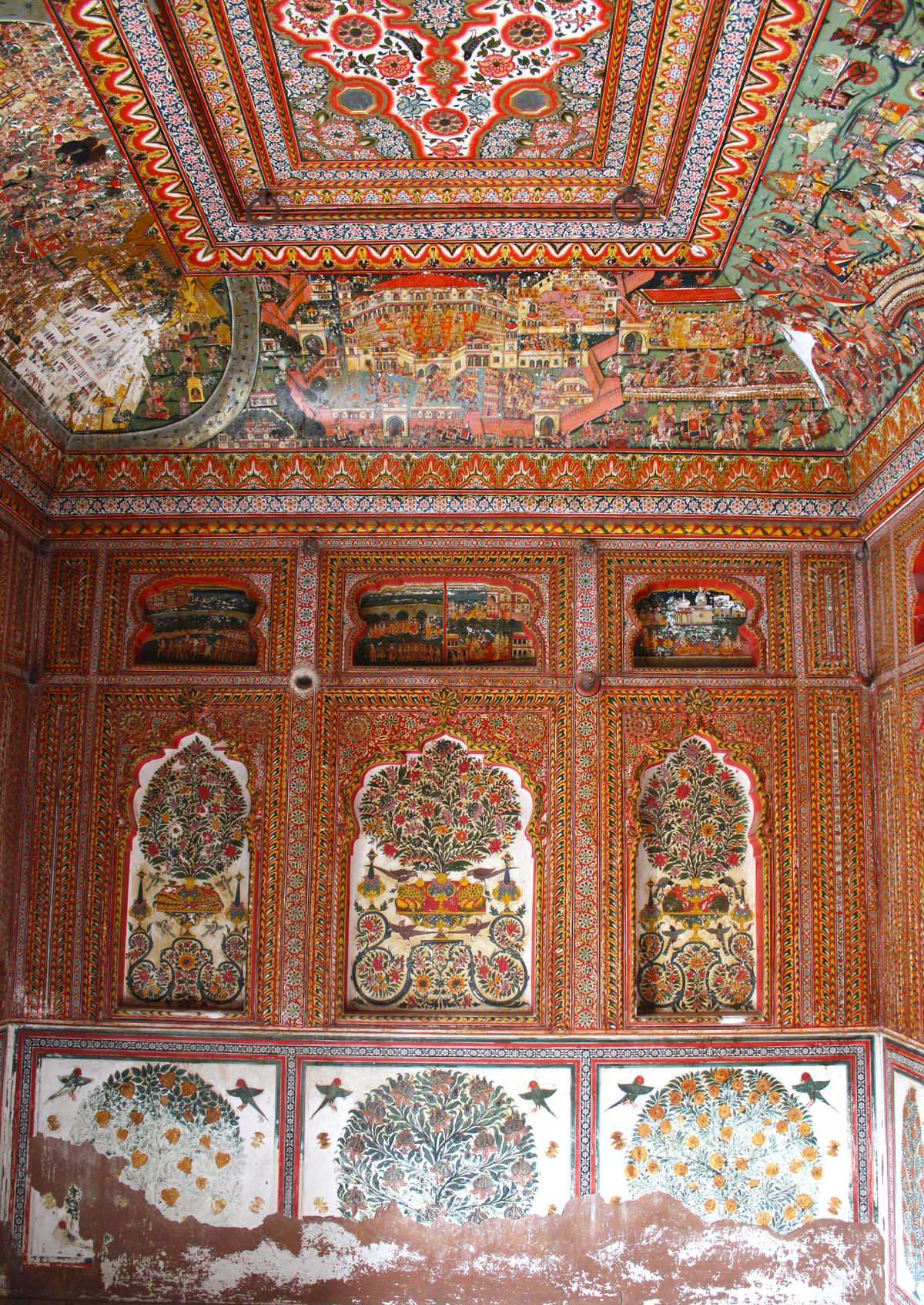
Sone ki dukan haveli’s work, Mahansar
| Photo Credit:
Garima Verma
The frescoes and murals that adorn every inch of these havelis are nothing short of archives, depicting the families’ wealth, travels, beliefs, and daily life. The paintings done on wet plaster or limestone, eight to 10 feet in height, are called frescoes, colloquially called aala-gila. Above that, the paintings on dry plaster, are murals. The scenes range from Hindu epics, Krishna’s raasleela being a favourite, the region’s royalty, European culture and cities, to new technology of the time like trains, telephones, airplanes.
Boasting of the region’s highest concentrations of painted havelis — close to 200, Nawalgarh is indeed one the most stunning living-art open air galleries in the world. In the mid-1900s Anandilal Podar Trust and MR Morarka-GDC Rural Research Foundation started the town’s restoration story with the Podar and Morarka havelis respectively. A few years later these specimens of Persian, Jaipur and Mughal school of paintings were opened as museums.
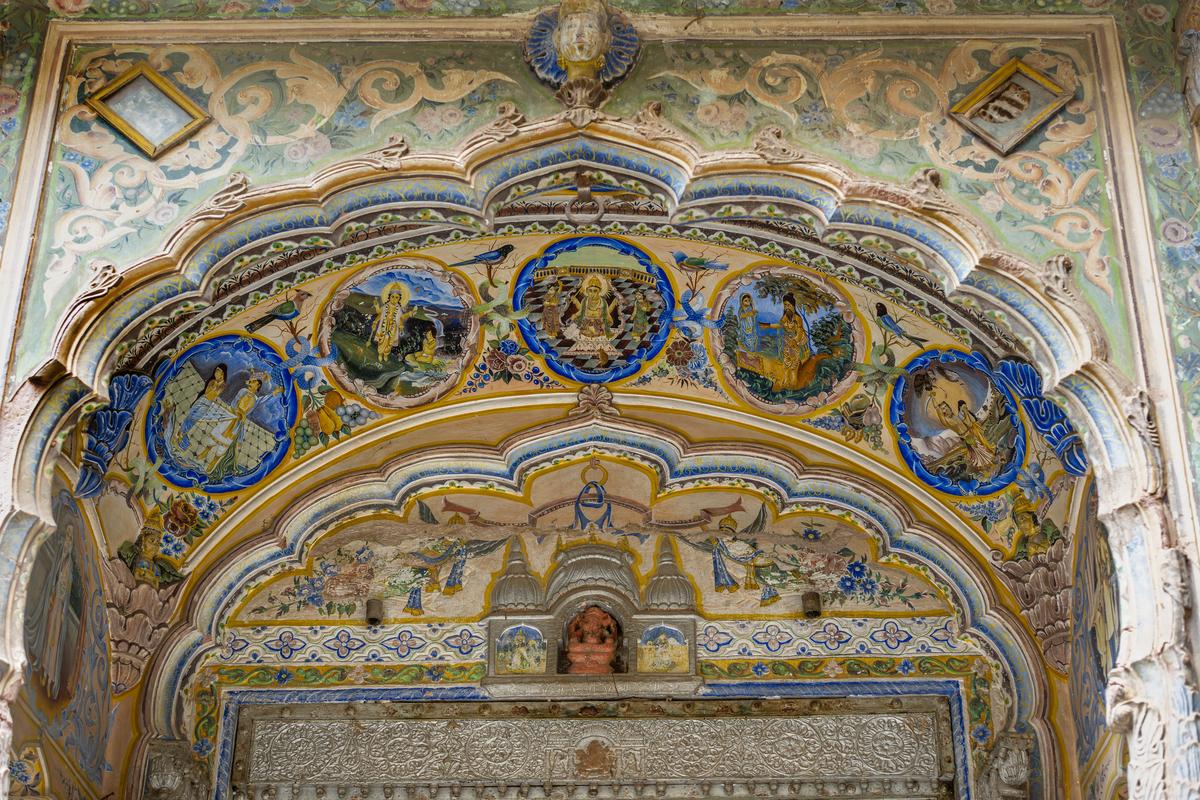
Murals depicting scenes of the Ramayana, Mahabharata, and more, above the courtyard door
| Photo Credit:
Garima Verma
And, with small towns and their architecture and culture now being the new hot destinations for Bollywood and OTT directors, the team of Tu Meri Main Tera Main Tera Tu Meri, starring Kartik Aryan and Ananya Pandey, also found its way to Nawalgarh in July 2025. Abid helped with the location scouting and permissions. Kartik stayed at the newly-restored Vivaana Museum Hotel, and even shared a sneak-peek of it on social media. Once belonging to the Jaipuria family, it was recently brought to life by Atul Khanna, a Delhi-based entrepreneur and Indian National Trust for Art and Cultural Heritage (INTACH) governing council member. He is also credited with restoring and turning two havelis in Old Delhi’s Sita Ram Bazaar into cultural centres. But it was right here in Shekhawati’s Churi Ajitgarh that this journey started for him almost a decade back with 19th century twin havelis, now Vivaana culture hotel.
“Architecture plays a crucial role in storytelling. Every building, with its unique elements and artefacts, has a story to tell, of its past and its people. And, having grown up in the lanes of Purani Dilli with a lot of nostalgia, saving the heritage of the country was always a goal,” shares Atul, while leading the tour of the Shekha museum on the ground floor of the one-of-its-kind museum-cum-hotel.
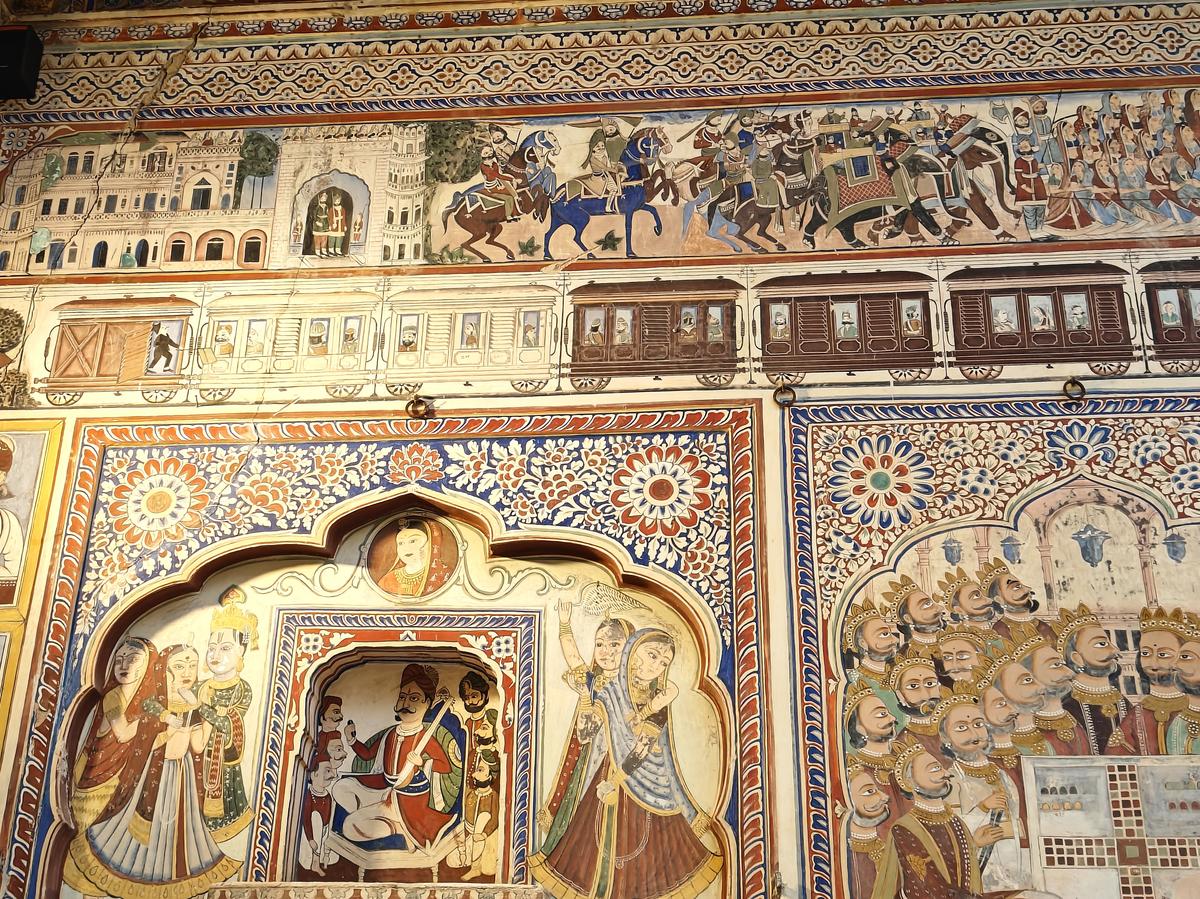
Meeting of era- Mahabharat’s game of chausar, Rajasthan’s royalties and a train in Podar Haveli.
| Photo Credit:
Garima Verma
Full of pieces showcasing the region’s culture and history, tribes and nomads of Rajasthan, antiques, a wall introducing all to little-known Molela terracotta art from Rajsamand, many of them are a result of Atul’s passion for collecting antiques. “I am a proud kabadiwalla (scrap dealer),” he quips, adding, “But all this heritage needs to be saved for the future generations. Restoring these havelis and art might be a painstaking process, but these are the heirlooms that need to survive.”
A reason why just a stone’s throw away, three havelis belonging to the Jhalan family, a Goenka home, and a few more are enjoying a new lease of life. The first one of the three has been restored using the close-to-original vegetable and mineral colours. The bright blue rightly highlights the murals depicting scenes from Lord Krishna’s life as it plays host to a similar video shoot. While the second one has lost just a bit of its former glory and serves as the family’s vacation house, it is the third one converted into a trust school that has lost most of its frescoes and murals to modern paint. “That haveli had one of the finest works, and that is what makes me cry,” Aabid says.
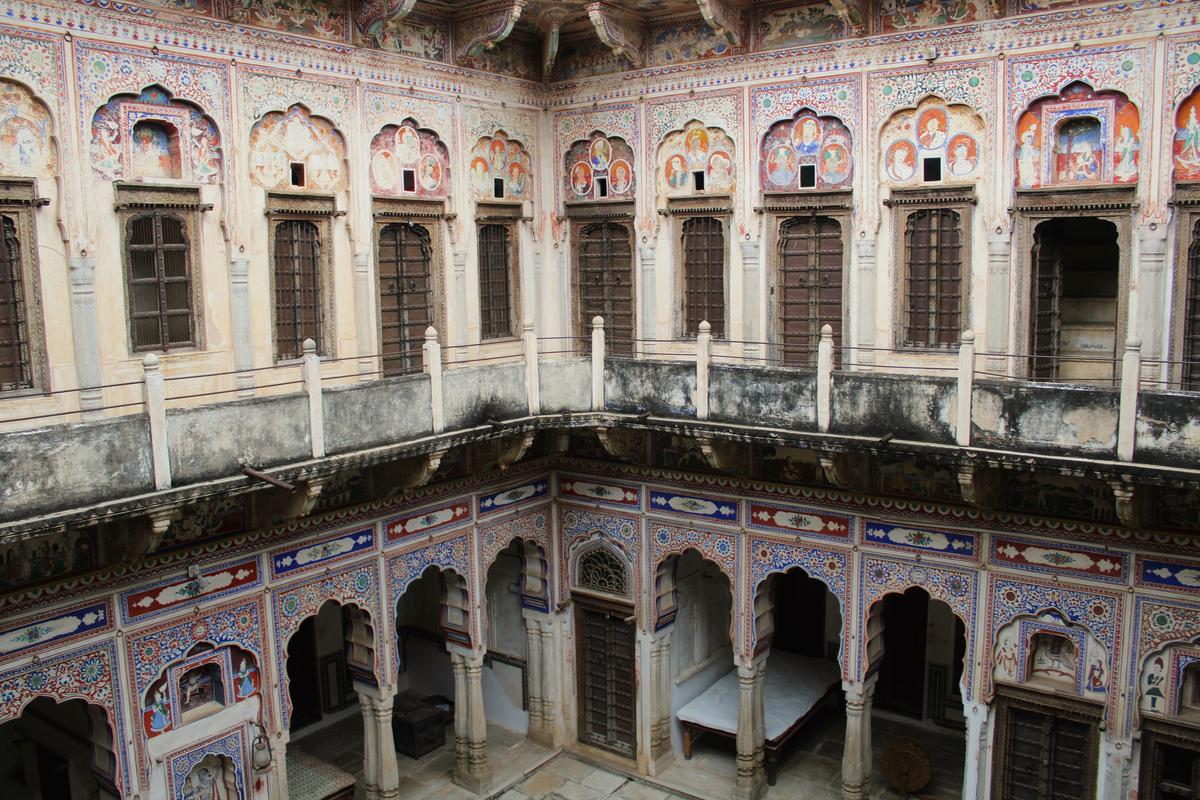
The double storeyed courtyard of Morarka Haveli Museum.
| Photo Credit:
Garima Verma
The dual-courtyard Goenka house might be a shinier version of its former self, all ready to host the now Mumbai-based family, but opposite it fifth-generation Runthla is waiting for enough economy to start reinstating his home and its art. But painter Bhairun Lal Swarnakar is happy to see more and more joining the list. The 75-year-old worked tirelessly for almost a decade on the Podar haveli’s murals numbering hundreds.
“There is still some work left. I will restart soon,” says the Bhilwara-based multi-awardee Bhairun, an expert in miniature, pichwai, and other forms. “I started in 1995 with recreating or finishing murals on the spaces where the plaster had fallen off on the outer walls of the haveli. And, it makes me happy to see that many people are making efforts to restore more and more havelis now. Just that I wish the new generation of the painters were taught the art of making the traditional colours, and using stuff like geru (Indian red earth), kajal (natural kohl), khadiya (clay)… The process is time-consuming but those colours survive and keep their original tint for a longer time.”
Still, it seems the journey that started with the Podar and Morarka havelis is slowly and steadily finding new storytellers, and while some are basking in their all-new glory, Nawalgarhs’s streets are dotted with many still waiting to be rescued. Perhaps soon!
How to reach: Though Nawalgarh has a railway station, it is best reached by road. Approximately 250 kilometres from Delhi; takes around six hours.
What else to do: A day trip to Mandawa, Fatehpur, Ramgarh (the 150-year-old cenotaph, called Ramgopal Podar Chhatri, has a ceiling full of intricate murals, including Krishna’s mahaaraas), and Mahansar (its Sone Ki Dukaan haveli is undoubtedly the finest work in the entire region; many inspired by traditional Persian carpets, with a lot of golden highlights).
