




BBC News, Wiltshire
BBC News, WIltshire

 PA Archive/PA Images
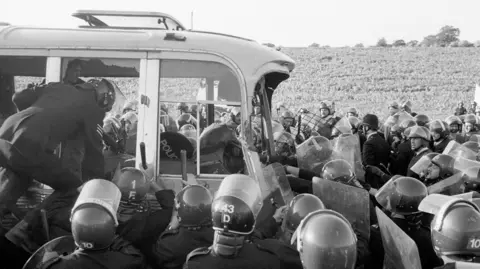
On a warm June afternoon in 1985, a convoy of more than 100 vehicles carrying people heading to a free festival at Stonehenge wound its way through the Wiltshire countryside. But they would never reach the ancient stones – instead many came away battered and bruised.
In their way were road blocks and hundreds of police officers determined to enforce an injunction preventing the festival goers reaching their destination, an injunction introduced as the free festival at Stonehenge had grown over the years.
What followed, according to some who witnessed it, was some of the worst violence involving police seen in the UK for decades. Both sides still dispute what happened, and the event was immortalised in song.
“I see a pregnant woman, lying in blood of her own.
“I see her children crying as the police tore apart her home.”
So goes the 1991 song ‘Battle of the Beanfield’ by indie folk band The Levellers – their telling of the story of what happened on 1 June 1985. The album it was on sold more than 300,000 copies that year, adding fame to an already infamous incident.
There have long been calls for a public inquiry into what happened that day, with some still asking for one to be held, although the Home Office has said there are no such plans.
In the current era, where festivals like Glastonbury are surrounded by huge security fences and tickets sell out in minutes, it may be hard to picture the free festival gatherings of 40 and 50 years ago.
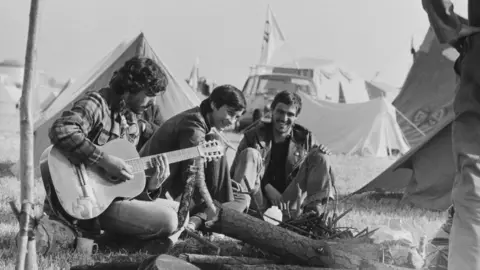
But from the early 1970s hundreds – then thousands – of people would make an annual pilgrimage to Stonehenge in the weeks building up to the solstice.
But as the size of the event grew – reaching 100,000 at its peak – so did the complaints. Of damage to the stones themselves, trespassing and vandalism.
Eventually the gathering became uncontrollable, in the eyes of the authorities, and an injunction was put in place to stop it.
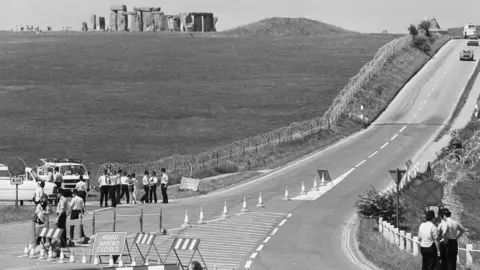
The summer of 1985 was the first festival season where the injunction was in place, and a four-mile exclusion zone was set up around the stones at the end of May.
Tonnes of gravel was tipped across roads, and a ring of barbed wire surrounded Stonehenge.
But that did not deter some. About midday on 1 June, a convoy of about 140 vehicles headed for the stones on a route taking them south on the A338.
The violence erupted when police blocked the convoy – with some officers claiming vehicles were driven at them – and many of the festival-goers ended up in a beanfield near the A303, where hundreds were arrested during hours of confrontations with the police.
An ITV journalist who filmed the events said it was some of the worst violence he had ever seen.
‘No middle ground’
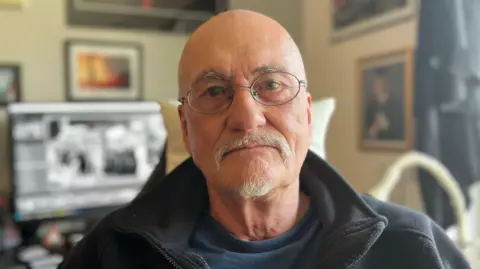
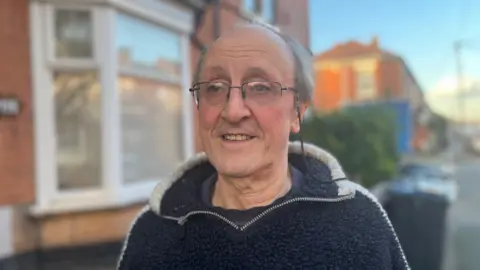
Alan Lodge was part of the convoy. While the Home Office has told the BBC it has no plans to launch a public inquiry, he said he thinks it is a “splendid idea”.
“I don’t really think that anybody has learned any lessons,” he said.
Mr Lodge had been going to free festivals with his family for years and decided to set up welfare provision at events at the time.
He remembers trying to discuss things with the police in the beanfield.
“I was trying to set up a line of communication so we could negotiate a way out of the situation,” he said.
“[But] there was no middle ground to be found.”
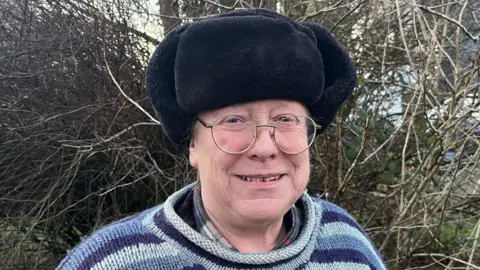
Helen Hatt also wants a public inquiry. She said she was left suffering from post traumatic stress disorder (PTSD) after the violence broke out.
“So much harm was caused to so many people – children were traumatised for life,” she said.
Her converted ambulance was part of the convoy.
“Police started smashing the windscreens of the vehicles at the front [of the convoy] and dragging people to ground, hitting them with truncheons.
“Somebody ran past me with a head wound and blood running down his face.”
‘Truncheon-wielding madmen’
Just 19 at the time, she said her vehicle’s windows were then smashed, and she was grabbed by the hair by two officers.
“I was in a tug-of-war with either side of my hair. I can remember how excruciating the pain of having both sides of hair pulled.
“I was screaming ‘stop, stop, tell me what to do’. I had people in the ambulance with me, cowering.”
At the time Ms Hatt was a festival entertainer called Bo Bo the Clown, and said she had trusted the police prior to June 1985.
But she described them as a “a wave of truncheon-wielding madmen” on that day.
“I had [vehicle] tax and MOT, so in my view I wasn’t doing anything wrong. I was on my way to work as Bo Bo the clown. That was my mindset.”
For their part, the police said officers were hit with missiles, and petrol bombs were also thrown in their direction.

There was one important witness to the incident – the Marquess of Ailesbury, who was then Lord Cardigan.
The owner of nearby Savernake Forest, he had encountered the convoy heading to Stonehenge and chatted with them.
“I wasn’t alarmed. I must have had some contact with the police – they told me in no uncertain terms they weren’t going to allow this convoy to get to Stonehenge.”
The Marquess followed the convoy on his motorbike and then saw “one of the most awful things I’d ever seen”.
He witnessed Ms Hatt, who he said was given no time to respond as the glass from her vehicle’s windows shattered, with police holding her head and feet.
“I was offended by the sight – she wasn’t armed, she wasn’t threatening. She was just in the wrong place in the wrong time.”
He later refused to give the police permission to access Savernake Forest, where other people who had been part of the convoy were sheltering.
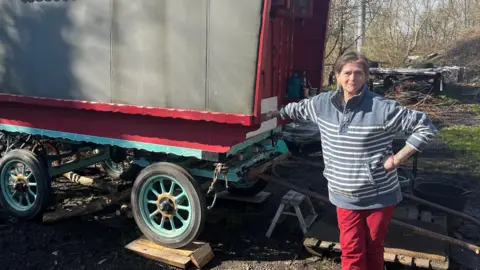
Rose Brash – who had her six-month-old daughter with her remembers the ploughed-up beanfield and explained that while some people in the convoy were stopped on the road, most pulled off trying to escape.
She said people had tried to escape and police charged at them “en masse”.
“I’ve never been so terrified as I was that day,” she said.
Members of the press were also there to watch events unfold.
Kim Sabido was an ITN reporter who broadcast from the scene. He told the BBC “it was like World War Three in a way”.
He saw vehicles from the convoy going “round and round”, while the police moved forward “like a military operation”.
The festival-goers wanted to get out, he said, but the police wanted to arrest them.
He said he did not see anything that would have provoked the police actions.
“The only thing you can say stepping back from it – they weren’t giving themselves up to the police as the police were asking them.”
More than 500 people were arrested in and around the beanfield that day.
During his reporting at the time, Mr Sabido called for a public inquiry into what had transpired, but he said he fears so long has now past that it would no longer be relevant.
He added that there should have been one shortly after the events in 1985, but believes the police approach to public order events has now changed and been “reassessed”.
“I would be fascinated if something like that happened again, how police would react,” he said.
“I think there would be an element of hesitation on behalf of the senior police officers… about how to try to pull back their approach.”
 Chris Moorhouse/Evening Standard/Hulton Archive/Getty Images
Paul Howlett, who was with Wiltshire Police at the time, said: “I wouldn’t for a minute suggest that everyone [at the festival] was violent or criminally inclined, but I think it’s important to remember there’s an element amongst them who were very anti-police, anti-establishment”.
He recalls a supermarket being ransacked during the festivals, people camping in woodland and chopping down trees for fires, but also police having bricks thrown at the vehicle they were sitting in, hitting the windscreen.
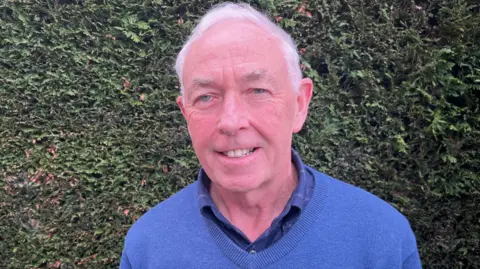
Pete Russ – also a former Wiltshire Police officer – said officers sometimes struggled just to get onto the festival site if they needed to, such as when they once had a call about an injured child.
“There was a very angry mob – we literally had to flee the site. It was a no-go area for the police at that time,” he said.
“If you’ve got 100,000 people with no form of control then clearly there’s a massive danger to everyone involved.”
Ms Hatt’s view is that if the festival was a town of 100,000 people “you can guarantee there would be a criminal in it” but that it does not justify “terrorising” anybody there to find them.
 PA Media
For the Battle of the Beanfield in 1985, Mr Russ was instructed to drive a gravel truck and dump it on the A338 to block the path of the convoy.
Mr Russ said he saw violence towards officers and, in his view, force was justified.
“They [the police] only had truncheons and shields versus vehicles that weighed 10 to 15 tonnes.”
The Marquess of Ailesbury said he did not see any of the vehicles being deliberately driven at officers.
Lionel Grundy, who has since died, was the deputy chief constable of Wiltshire Police at the time.
Speaking to the BBC in the early 2000s, he said offcers wanted to find the culprits behind bottles of petrol allegedly thrown at police, as well as petrol theft.
“I had reports they were starting engines and lining up vehicles. The manner they were forming themselves up looked like they were going to Stonehenge.
“I ordered my men to arrest the people in the field.”
‘Much has changed’
Nearly six years after the events of June 1985, a four-month trial into the actions of Wiltshire Police was held at Winchester Crown Court, after 24 members of the convoy sued the force for wrongful arrest, assault and criminal damage.
Both sides claimed victory afterwards. The police were cleared of wrongful arrest, but the convoy members were awarded £24,000 for damage to “persons and property”.
The line was drawn under the Battle of the Beanfield, but it wasn’t the end of the story.
For years afterwards, people trying to get to Stonehenge to celebrate the solstice would clash with police trying to stop them.
Wiltshire Police told the BBC that “much has changed” since 1985.
Supt Steve Cox, head of specialist operations, said: “I respect the fact that the events of that day in 1985 may be personally felt, and will have impacted on people in a variety of ways.”
He said the force reflects on everything it does, and seeks to learn lessons from major events.
Adding that English Heritage now allows free access to Stonehenge to celebrate the solstice, he added: “We police the solstice celebrations at both Stonehenge and Avebury in the same proportionate way that we police any other public event.
“Public safety is our priority.”
