




Jo PalmerSouth & South East Investigations Team

 BBC
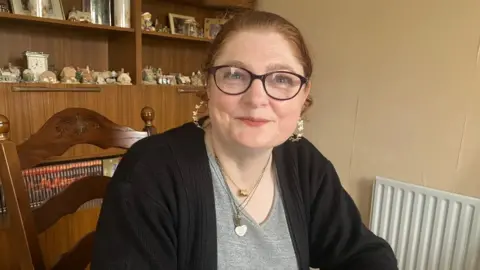
BBCA woman who spent 25 years hiding the fact she could not read has said there should be more support for adults with undiagnosed dyslexia.
Charities have warned hundreds of thousands of adults across England and Wales could be struggling without a clear or free diagnosis pathway.
The British Dyslexia Association, based in Bracknell, is calling for a national strategy to stop people slipping through the net.
Paula Randall, from Basingstoke, said she spent two decades feeling embarrassed and making excuses to avoid reading in public.
“When I was at secondary school the teachers just looked at me and put me at the back of the class saying I didn’t want to learn,” she said.
“I was disruptive. They just kind of basically ignored me.”
Ms Randall was eventually diagnosed with dyslexia, but too late to help her during her GCSEs.
“I went into that hall, I felt sick and just thought what’s the point,” she said.
“I just literally wrote my name date of birth on the exam paper. Basically I just didn’t do my exams.”
‘I just wanted to end it’
Ms Randall said afterwards she was so distraught she even contemplated taking her own life.
She said: “I got home and I just wanted to end it. I thought I’ve got no qualifications. I’ve got no reason to be here. I’m an embarrassment to my mum and my family. I just thought ‘why not’?”
Ms Randall said in later life she came up with creative solutions for everything from eating out to doing the weekly shop.
“I would always make excuses, for why I didn’t want to order from the menu, and put on a fake smile,” she said.
“It’s amazing how many times you can put on a fake smile.”
 British Dyslexia Association
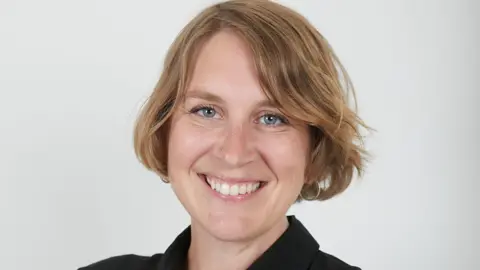
Ellen Broomé, chief executive of the British Dyslexia Association, said: “It is shocking that we let adults go through life unsupported and that feels like such a waste.
“Not just for the economy. It’s a big waste for the economy and the taxpayer but a waste of human potential.
“With autism or ADHD, you might be able to go to your GP and say ‘this is my problem’ or ‘this is what I am struggling with’ and there will be a pathway.
“There might be long wait lists. For adults with dyslexia that pathway does not exist.”
A dyslexia diagnosis is not available via the NHS, as it is recognised as a specific learning difficulty.
This means it requires an educational assessment, which cost about £700 to pay for privately.
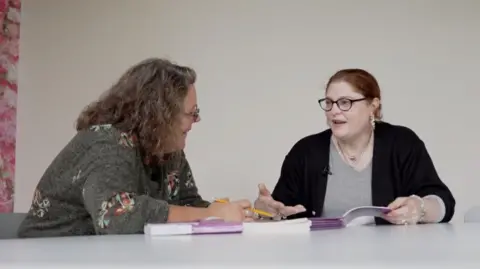
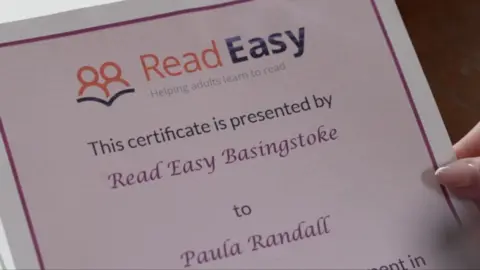
When Ms Randall was 42 she reached out to the charity Read Easy, which helps adults learn to read on a 1-2-1 basis.
She said learning to read had transformed her life.
“A lot of my friends, my husband and my mum said ‘even you just going for those first couple of lessons, we noticed that confidence has come out in you’,” she said.
“I’m actually proud to say I have it now. I don’t need to hide or do anything.
“It’s ‘yes, I’m Paula from Basingstoke, I have dyslexia, I’m here to help you’.”
Amanda Lightowler is a specialist tutor for children and adults at Helen Arkell Dyslexia Charity in Surrey.
She said the barriers for adults with undiagnosed dyslexia were wide-reaching.
“I think the difficulty for an individual trying to find an answer is the assessments are quite expensive,” she said.
“They can be up to £800, and although that’s because of the time and expertise involved, a lot of people don’t have that money.
“It’s the price of a holiday and lots of people aren’t even having them at the moment.
“A lot of the information is online and that is a barrier. Everything is very word based, even internet searches, so trying to access the information is tricky.”
Also backing the call from the British Dyslexia Association is Robert Glick, founder and CEO of the Adult Literacy Trust.
He believes a national strategy is essential to stop more adults like Ms Randall slipping through the net.
“What’s really required to achieve both impact and efficiency in adult literacy provision is a truly ‘whole government’ approach,” he said.
“We need to address the lack of ownership and dilution of effort around literacy that stems from it being an issue which cuts across a range of policy areas.
“This should include creating a national task force or cross-departmental working group.”
The Adult Literacy Trust estimates very poor adult literacy levels costs the UK economy as much as £40bn per year in lost productivity and reduced earnings.
A spokesperson for the Local Government Association said: “There is no legal responsibility of local authorities for adult dyslexia diagnosis.
“Adult dyslexia diagnoses should be carried out by a qualified specialist assessor and are typically provided by the private and voluntary sector.
“If an adult with a formal dyslexia diagnosis has care and support needs, councils have a duty under the Care Act 2014 to undertake a social care needs assessment and to meet those needs if they are deemed eligible.”
