



Laura May McMullanBBC Midlands Today

 BBC
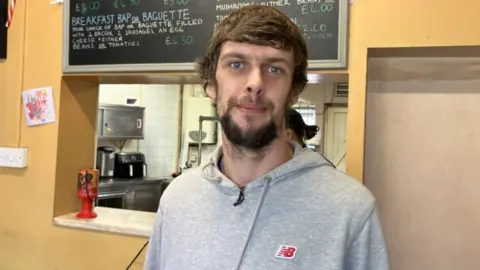
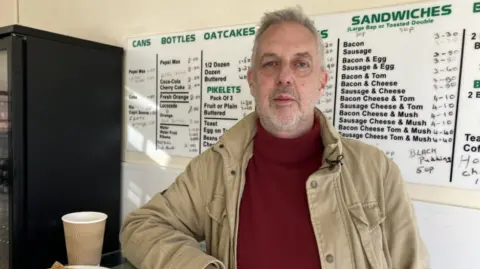
BBCA photographer has spent two years taking pictures of oatcake shop owners and their customers for a book celebrating the north Staffordshire delicacy.
Stoke-on-Trent-born David Fletcher hopes the photobook, called Tunstall Tortillas, will help to highlight the local industry and the culture around them.
“I thought the shops would probably be declining, and I was quite surprised to find that they’re not, and in fact they are thriving,” he said.
There are 42 oatcake shop owners across Stoke-on-Trent, with the history of the delicacy dating back to the 18th Century.
The food might not look very special, but it is when you taste it, said Mr Fletcher, who describes the shops as being like community hubs.
“Eveyone has their own favourite oatcake shop,” he said.
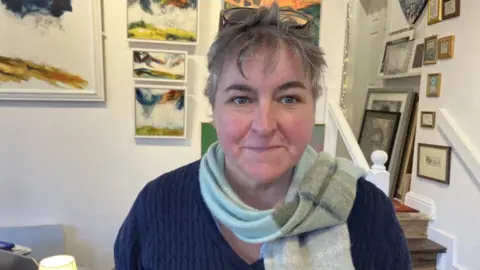
Amanda Bromley from Barewall Art Gallery, where the book has its official launch on Saturday, said it was a “fresh look” at the oatcake through the shop owners, as they “very rarely get a mention.”
It was about time the vendors were celebrated as they “do a great job of keeping the oatcake-eating culture alive in the Potteries.”
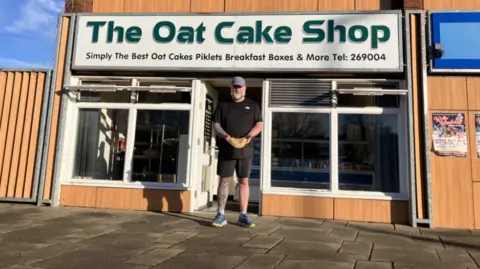
At Craig Nicholson’s shop, a business he took over from his parents 22 years ago, they use a traditional handpouring technique to produce the oatcakes which he says are hard to explain to the uninitiated, but come out “just amazing, they are lovely”.
Behind the curtain, however, the traditional treat is made from a recipe typically including oatmeal and yeast – and look rather like a wet flannel.
But it is the filling, such as bacon and cheese, that makes all the difference.
A midlands crepe, then? A Potteries pancake? No, an oatcake.
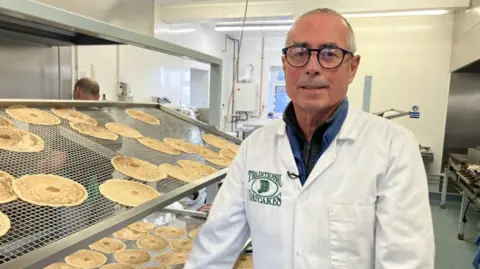
Another featured vendor is John Broadhurst, who has been serving oatcakes for four decades, and his business dates back to 1934.
He said the oatcake “symolises the people of Stoke-on-Trent, as much as the pots”.
But just 10 to 20 miles outside of the city, many people did not know what they were, he said.
The history of the oatcake has been much debated, but the making of them is an inherited tradition, and they are not to be confused with Scottish oatcakes, which are more biscuit-like.
North Staffordshire’s rural tradition of oatcake making turned into a booming cottage industry with the expansion of pottery and mining during the industrial revolution.
That led to specialised premises with coal-fired bakestones churning out thousands of oatcakes in order to satisfy the appetites of new workers.
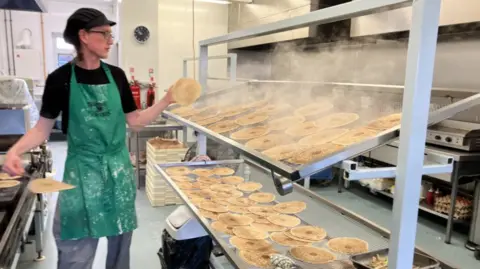
One of the area’s younger oatcake shop owners is 35-year-old Dan Yates whose approach to marketing might mean that oatcake culture widens.
Since April, he has been using social media to sell his wares to a much wider geographical audience.
“We’re approaching a slightly different method with online, TikTok, Facebook; this sort of crowd we’re looking to bring in,” he said.
“We’re getting lots of new followers, lots of new people.”