





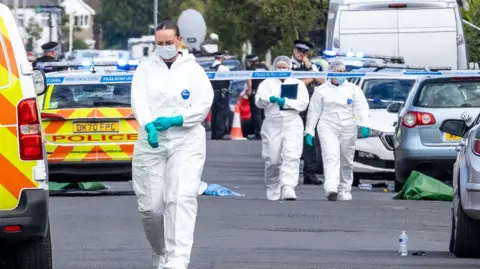
 PA Media
A mental health assessment carried out six days before the Southport knife attacks, which found the killer posed no risk to others, was “wholly inappropriate and wrong”, a public inquiry has heard.
The Southport Inquiry was also told the child and adolescent mental health service (CAMHS) had overly focused on the risk Axel Rudakubana, then 17, posed to himself rather than to others.
The hearing at Liverpool Town Hall heard from Tina Irani, an independent consultant child and adolescent forensic psychiatrist.
When asked about how mental health services had dealt with Rudakubana in the lead-up to the 29 July 2024 attacks, Dr Irani described their assessments as “not adequate”.
‘Inadequate and wrong’
Alice da Silva Aguiar, nine, Elsie Dot Stancombe, seven, and six-year-old Bebe King were fatally attacked at a Taylor Swift-themed dance workshop.
Ten others, including eight children, were seriously injured.
In January the perpetrator, from Banks in Lancashire, was jailed for life with a minimum term of 52 years.
Dr Irani was asked about her assessment of how the local CAMHS service and the local forensic child and adolescent mental health service (FCAMHS) had treated him.
Nicholas Moss KC, counsel to the inquiry, put it to Dr Irani that a CAMHS assessment of the killer six days before the attack which read “poses risk to others: none” was “wholly inadequate and wrong”.
Dr Irani agreed it was.
By that stage a number of agencies were aware that he had taken a knife to school and had attacked a fellow pupil with a hockey stick.
However, some details of the knife incidents were not included in a CAMHS assessment.
Mr Moss asked Dr Irani for her opinion of the quality of the risk assessment [by CAMHS] “bearing in mind the seriousness of the events [Rudakubana] had been involved in”.
She replied: “That isn’t a risk assessment – that just highlights what concerns were at the time. So that’s not really a risk assessment.”
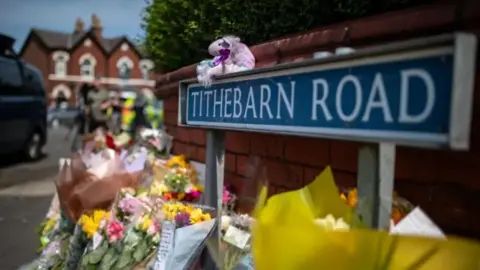 PA Media
Dr Irani said assessments undertaken by CAMHS and FCAMHS were “not adequate”.
She agreed with Mr Moss that “what ended up happening was that CAMHS focused especially in the later years – 2022, 2023, 2024 – on the risk to [Rudakubana] and not enough on the risk [he] posed to others.”
Dr Irani said she wanted to make it clear that “not every young person [with mental health problems] needs an extensive risk assessment, but where there are indications that this should be completed”.
She agreed that the killer fell within that category “by some margin”.
‘Fascination with violence’
Dr Irani suggested the inquiry consider whether there should be new laws to allow parents and agencies to monitor the online activity of young people with a fascination for violence.
The inquiry has previously heard the attacker had watched violently graphic videos on the internet.
In her report for the inquiry, Dr Irani said there were no laws about internet monitoring unless a person had been charged with a criminal offence.
Suggesting that because young people are more adept online than their parents, Dr Irani said inquiry chairman Sir Adrian Fulford should consider – where there are specific safeguarding or risk concerns – whether a legal framework could support families monitoring and supervising their children’s internet use.
She said he should “give consideration to compulsory powers to include monitoring what young people who have a fascination with violence might be doing online”.
Dr Irani agreed with Sir Adrian when he said this would mean “the ability of clinicians to walk up the stairs and knock on the bedroom door [of a young person’s room] and insist on [seeing] things.”
The inquiry continues.
