



Even for those of us who follow these kinds of things on a regular basis, the spending review is, frankly, a bit of a headache.
This is one of the biggest moments in Britain’s economic calendar – bigger, in some respects, than the annual budget.
After all, these reviews, which set departmental spending totals for years to come, only happen every few years, while budgets come around every 12 months (or sometimes more often).
Yet trying to get your head around the spending review – in particular this year’s spending review – is a far more fraught exercise than with the budget.
In large part that’s because the Office for Budget Responsibility (OBR), the quasi-independent body that scrutinises the government’s figures, is not playing a part this time around.
There will be no OBR report to cast light, or doubt, on some of the claims from the government. Added to this, the data on government spending are famously abstruse.
So perhaps the best place to start when approaching the review is to take a deep breath and a step back. With that in mind, here are five things you really need to know about the 2025 spending review.
1. It’s not about all spending
That might seem like a strange thing to say. Why would a spending review not concern itself with all government spending? But it turns out this review doesn’t even cover the majority of government spending in the coming years.
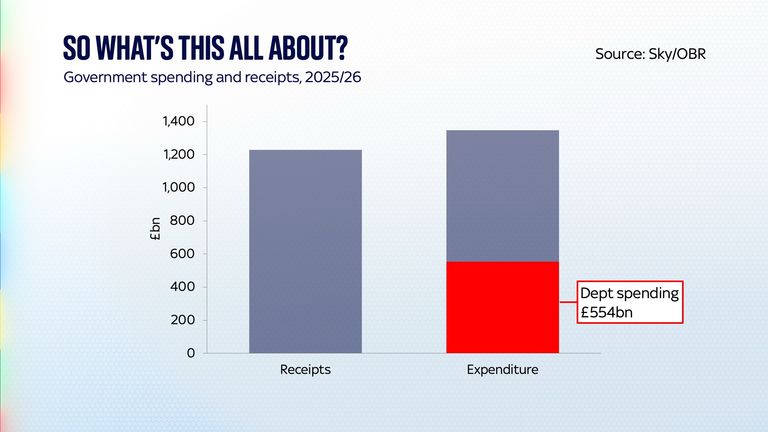
To see what I mean you need to remember that you can split total government spending (£1.4trn in this fiscal year) into two main categories.
First there’s what you might call non-discretionary spending. Spending on welfare, on pensions, on debt interest.
This is spending the government can’t really change very easily on a year-to-year basis. It’s somewhat uncontrolled, but since civil servants wince at that idea, they have given it a name that suggests precisely the opposite: “annually managed expenditure” or AME.
Then there’s the spending the government has a little more control over: spending in its departments, from the Ministry of Defence to the NHS to the Home Office.
This is known as “departmental spending”. This is what the spending review is about – determining what departments spend.
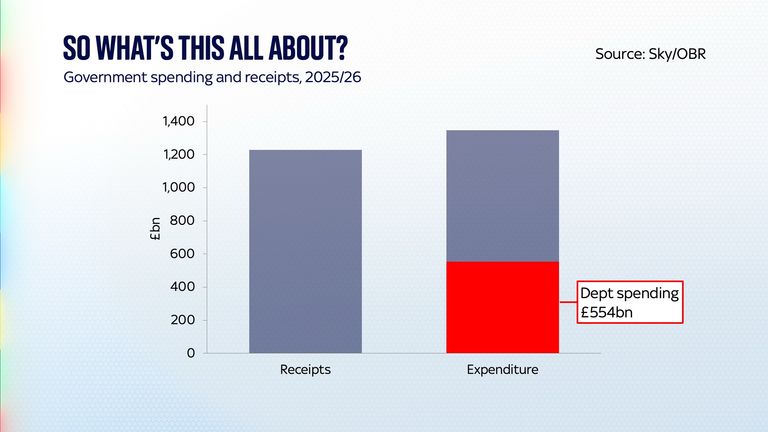
The key thing to note here is that these days departmental spending (actually, to confuse things yet further, the Treasury calls it Departmental Expenditure Limits or DEL) is quite a bit smaller than AME (the less controlled bit with benefits, pensions and debt interest costs).
In short, this spending review is actually only about a fraction – about 41p in every pound – of government spending.
You can break it down further, by the way. Because departmental spending can be split into day-to-day spending (Resource DEL) and investment (capital DEL). But let’s stop with the acronyms and move on to the second thing you really need to know.
2. It’s a “zero-based” review. Apparently
The broad amount the government is planning to spend on its departments was set in stone some time ago. The real task at hand in this review is not to decide the overall departmental spend but something else: how that money is divided up between departments.
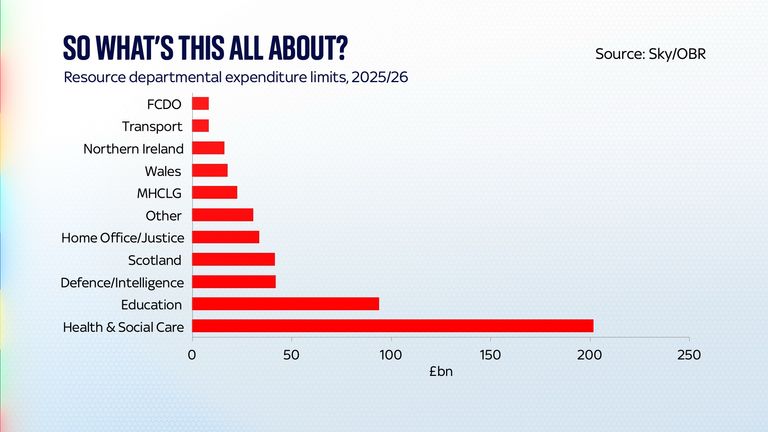
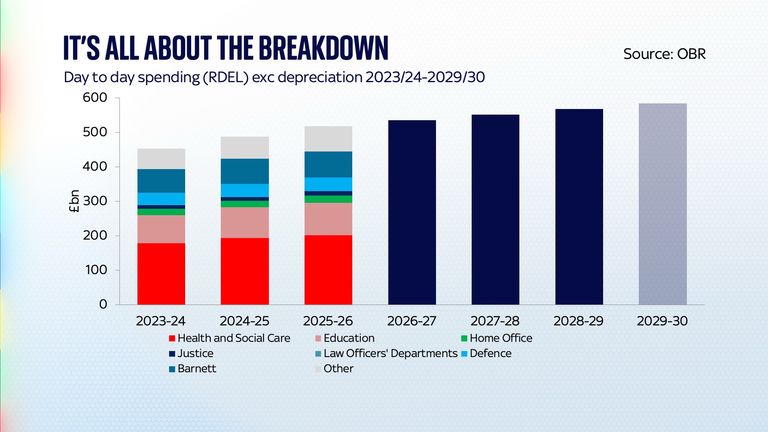
Consider: in this fiscal year (2025/26) the government is due to spend just over £500bn of your money on day-to-day expenditure.
Of that, by far the biggest chunk is going to the NHS (£202bn), followed by education (£94bn), defence (£39bn) and a host of other departments. That much we know.
In the next fiscal year, we have a headline figure for how much day-to-day spending to expect across government. What we don’t have is that breakdown.
How much of the total will be health, education, defence and so on? That, in a sense, is the single biggest question the review will set out to answer.
Now, in previous spending reviews the real debate wasn’t over those grand departmental totals, but over something else: how much would they increase by in the following years?
This time around we are told by Rachel Reeves et al that it’s a slightly different philosophy. This time it’s a “zero-based review”.
For anyone from the world of accountancy, this will immediately sound tremendously exciting. A zero-based review starts from the position that the department will have to justify not just an annual increase (or decrease), but every single pound it spends.
It is not that far off what Elon Musk was attempting to implement with the DOGE movement in US government – a line-by-line check of spending.
That’s tremendously ambitious. And typically zero-based reviews tend to throw out some dramatic changes.
All of which is to say, in theory, unless you believed government was run with incredibly ruthless efficiency, if this really were a zero-based review, you’d expect those departmental spending numbers to yo-yo dramatically in this review. They certainly shouldn’t just be moving by small margins.
Is that really what Whitehall will provide us with in this review? Almost certainly not.
Read more from Sky News:
UK unemployment rises to highest in four years
M&S climbs after online order breakthrough
3. It’s the first multi-year review in ages
What we will get, however, is a longer-range set of spending plans than government has been able to provide in a long time.
I said at the start that these reviews are typically multi-year affairs, setting budgets many years in advance.
However, the last multi-year review happened in the midst of COVID and you have to look back to 2015 for the last multi-year review.
That certainty about future budgets matters for any government department attempting to map out its plans and, hopefully, improve public sector productivity in the coming years.
So the fact that this review will set spending totals not just for next fiscal year but for the next three years is no small deal.
Indeed, for investment spending (which is actually the thing the government will probably spend more time talking about), we get numbers for four successive years. And the chances are that is what the government will most want to talk about.
4. It’s not “austerity”
One of the big questions that periodically returns to haunt the government is that we are heading for a return to the austerity policies prosecuted by George Osborne after 2010.
So it’s worth addressing this one quickly. The spending totals implied by this spending review are nothing like those implemented by the coalition government between 2010 and 2015.
You get a sense of this when you look at total public spending, not in cash or even inflation-adjusted terms (which is what the Treasury typically likes to show us), but at those figures as a percentage of GDP.
Day-to-day spending dropped from 21.5% of GDP in 2009/10 to 15% of GDP in 2016/17. This was one of the sharpest falls in government spending on record.
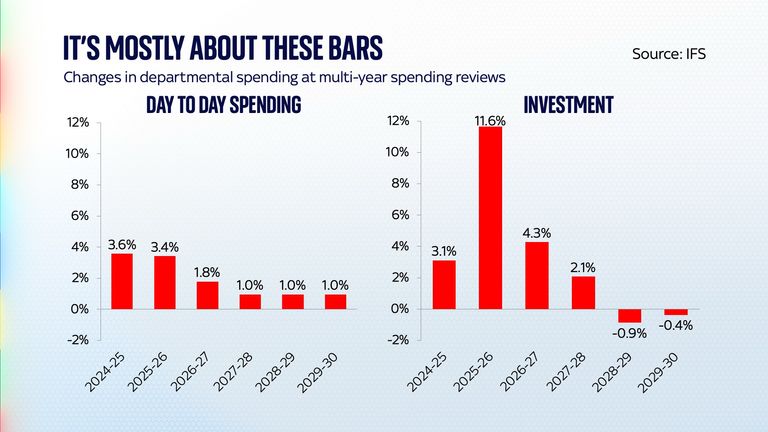
By contrast, the spending envelope for this review will see day-to-day spending increasing rather than decreasing in the coming years.
The real question comes back to how that extra spending is divided between departments.
Much money has already been promised for the NHS and for defence. That would seem, all else equal, to imply less money for everyone else.
But overshadowing everything else is the fact that there’s simply not an awful lot of money floating around.
5. It’s not a big splurge either
While the totals are indeed due to increase in the coming years, they are not due to increase by all that much.
Indeed, compared with most multi-year spending reviews in the past, this one is surprisingly small.
In each year covered by the 2000 and 2002 comprehensive spending reviews under Gordon Brown, for instance, capital investment grew by 16.3% and 10.6% respectively.
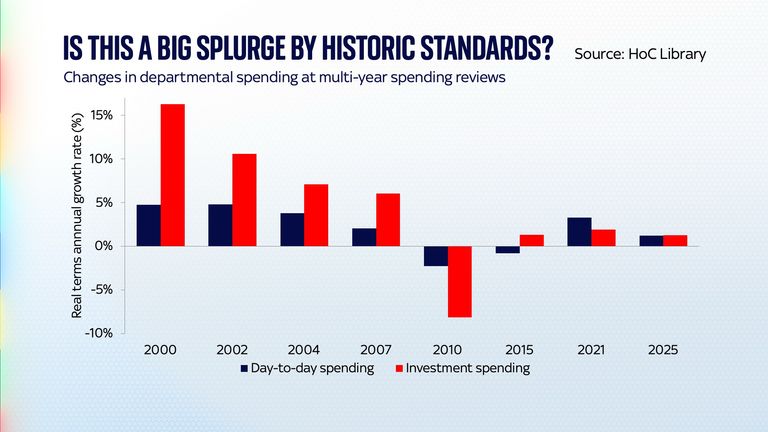
This time around, it’s due to increase by just 1.3%. Now, granted, that slightly understates it. Include 2025/26 (not part of this review but still a year of spending determined by this Labour government) and the annual average increase is 3.4%.
Even so, the overall picture is not one of plenty, but one of moderation.
While Rachel Reeves will wax lyrical about the government’s growth plans, the numbers in the spending review will tell a somewhat different story. If you can get your head around them, that is.
